

The most common reservation about vinyl flooring in Singapore is the one that flooring suppliers rarely address directly: will it look fake? It is a fair question. Older vinyl flooring had a reputation for looking plasticky, feeling hollow, and convincing no one. The embossed wood patterns were too uniform, the grain lines too repetitive, and the surface too shiny to pass close inspection.
Modern LVT has moved so significantly beyond that starting point that the comparison is barely useful. Understanding how contemporary wood-look LVT actually achieves its visual and tactile realism, through embossed-in-register (EIR) technology, high-definition printing, and carefully specified surface finishes, allows homeowners to evaluate what they are looking at rather than what they remember from an earlier generation of products.
How Modern LVT Mimics Real Wood: Embossed-in-Register Explained
The technology that transformed wood-look LVT from a visual compromise to a genuine alternative is embossed-in-register (EIR) surface processing. Understanding what EIR means explains why premium LVT now convinces on both visual and tactile levels.
Standard vinyl flooring uses a printed pattern and a separately applied emboss texture. The problem is that the texture is applied uniformly across the surface without reference to the printed image beneath it. A wood grain pattern has deep pore channels running along the fibres, raised grain lines between them, knot depressions where the growth rings tighten, and subtle surface variation throughout. Standard embossing applies the same texture regardless of what the print shows, so the printed grain and the physical texture are misaligned. Your eyes see wood; your fingers feel something generic.
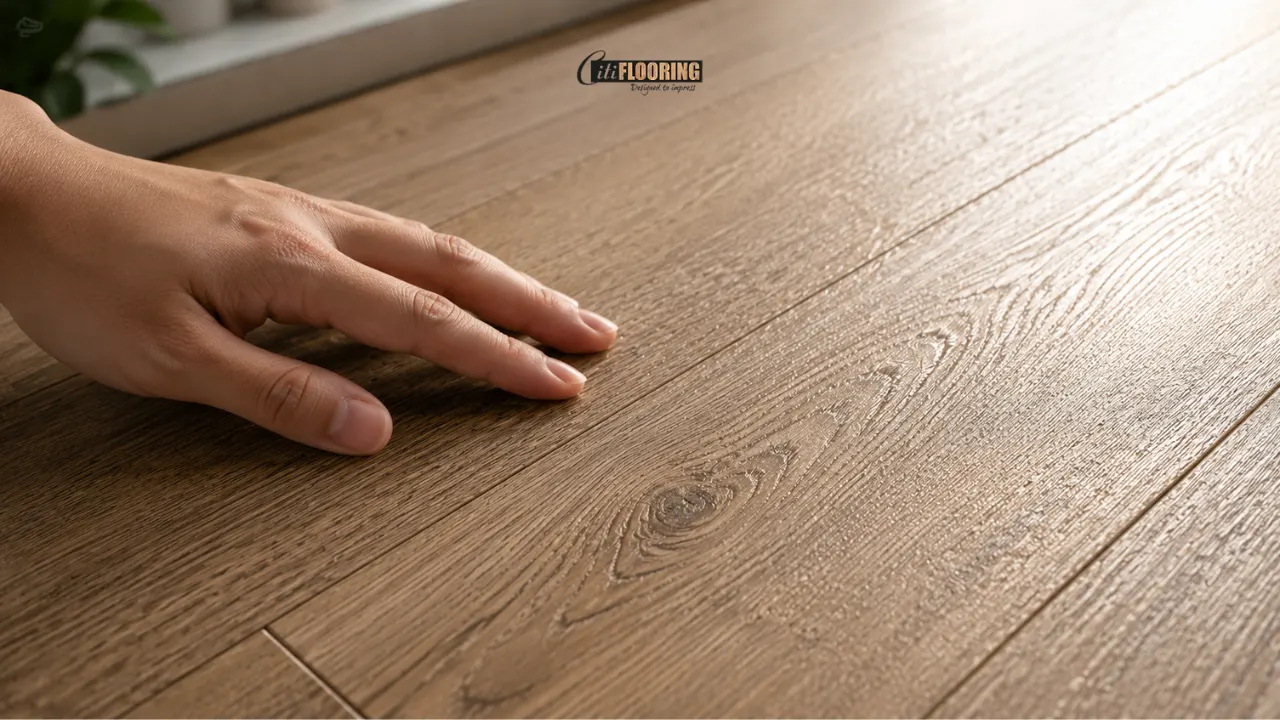
EIR technology registers the physical emboss texture precisely to the printed image. When the print shows a dark grain channel, the press plate creates a physical depression at exactly that point. When the print shows a raised grain ridge, the plate creates a corresponding surface elevation. The result is a floor where visual and tactile information are aligned, which is how real wood works. Your eyes see grain; your fingers confirm it.
This alignment produces two effects that matter for realism. First, it makes the floor convincing in raking light, the angle where most surfaces reveal their true nature. Standard embossed vinyl under raking light shows a uniform texture pattern that reveals its non-wood origin. EIR LVT under raking light shows the same irregular, organic variation that real wood does. Second, it makes the floor convincing underfoot, which is where people spend the most contact time with a floor surface.
Wood-Look LVT vs Engineered Wood
Wood-look LVT and engineered wood occupy adjacent positions in Singapore’s flooring market, and the comparison between them is the most practically relevant one for homeowners choosing between natural and LVT options.
Engineered wood is a genuine wood product: a veneer of natural timber bonded to a plywood or HDF core. It looks like real wood because it is real wood on the surface, and the most convincing engineered wood floors are genuinely beautiful. But in Singapore’s climate, engineered wood carries risks that LVT avoids.
Humidity movement is the primary concern. Singapore’s ambient humidity, combined with the temperature differential between air-conditioned interiors and external conditions, creates conditions under which natural wood veneers move. Engineered wood is more stable than solid timber, but it is not immune to cupping, gapping, or surface checking when humidity fluctuates significantly. In HDB homes without consistent air conditioning, this movement accumulates over years.
Maintenance is the second differentiator. Engineered wood requires periodic refinishing, careful cleaning with wood-specific products, and immediate attention to spills to prevent moisture penetration. LVT requires none of these. The wear layer handles daily use without degradation that requires refinishing, and any standard floor cleaner is safe.
Cost is the third separator. Quality engineered wood in Singapore typically costs S$8 to S$20 per square foot installed, before the premium for full-flat coverage and the ongoing maintenance cost. Wood-look LVT sits at S$4 to S$8 per square foot installed, with no ongoing cost burden.
The honest answer to “which is better” is that engineered wood provides a natural material experience that even the best LVT does not fully replicate at very close range. LVT provides a dimensional stability, waterproofing, and maintenance simplicity that engineered wood cannot match. For most Singapore residential applications, the performance advantage of LVT is more relevant to daily life than the marginal authenticity advantage of engineered wood.
Best Wood-Look LVT Designs in Singapore
The wood-look LVT market in Singapore is dominated by several specific aesthetic directions, each of which maps to the dominant interior styles in Singapore’s renovation culture.
Pale wood tones, the light oaks, bleached ash, and blond maple aesthetics, lead the market in volume. They suit Japandi, Scandinavian, and contemporary minimalist interiors, and their brightness makes them particularly effective in the lower-ceiling HDB spaces that make up the majority of Singapore’s residential stock. The visual effect is an expansion of the space rather than an anchoring of it.
Mid-tone warm browns, cherry oak, gentle oak, chestnut, occupy the largest range in the CORE+ collection and suit the broadest range of interior directions. They provide the warmth that naturally gravitated toward real wood without the commitment of a very dark or very light extreme. These tones work in transitional, contemporary classic, and family-oriented interiors where the floor should feel warm and welcoming.
Darker tones, mahogany, dark walnut, suit dramatic, sophisticated interiors where the floor is intended to create presence. In condos with good natural light and ceiling heights that can accommodate the visual weight of a dark floor, these tones create a richness that commands a room.
Grey-toned wood, the grey ashes and grey oaks that straddle the boundary between wood tones and cool neutrals, suit contemporary minimalist and Japandi directions and are among the most photographically compelling options in the Singapore market.
Caring for Wood-Look LVT
Wood-look LVT is significantly easier to care for than real wood, and the care regime is simple enough that it needs only brief explanation.
Routine cleaning involves sweeping or vacuuming to remove grit and debris that can scratch the wear layer if left to accumulate and be ground underfoot. Damp mopping with a mild, pH-neutral floor cleaner handles spills and surface soiling. No waxing, no oiling, no specialist wood cleaning products, and no concern about what cleaning agent touches the surface.
The primary care recommendation is protecting the wear layer from concentrated abrasion. Furniture leg protectors prevent scratches from chair and table legs being dragged across the floor. Door mats at entry points capture grit before it is tracked onto the floor surface. These are standard practices in any well-maintained home and require no special effort.
Unlike real wood, wood-look LVT does not require periodic refinishing. The wear layer degrades gradually over years of use, and in normal residential conditions CORE+’s 0.5mm wear layer provides 15 to 20 or more years of service life before the surface appearance is affected.
Citiflooring’s Wood-Look Range
Citiflooring’s CORE+ wood-grain series covers the full spectrum of wood tones that Singapore interiors demand, from the palest to the richest.
C2021 Cherry Oak is a warm, medium-rich reddish-brown that sits at the conventional heart of the wood tone spectrum. Its warmth suits traditional and transitional interiors and pairs naturally with dark metal fixtures and upholstered furniture.
C2026 Brown Ash is a slightly cooler, medium brown with strong grain definition, one of the most versatile wood-look options in the range because its tone is warm without being dominant and its grain is defined without being distracting.
C5520 Maple is a pale, very light warm blonde that maximises spatial brightness and suits Japandi and Scandinavian interiors where the floor should read as airy rather than grounded.
C1001 Sicilian Walnut is the richest dark tone in the collection, a deep, characterful walnut that creates maximum presence and suits sophisticated, design-led interiors where the floor is the anchor.
Explore wood-look LVT from the CORE+ collection and browse Citiflooring’s wood designs in completed installations to see how each tone reads in real Singapore homes.
Frequently Asked Questions
At what distance does wood-look LVT reveal itself as not real wood? With quality EIR-textured LVT, the floor does not reveal itself as vinyl at normal living distances. The visual and tactile cues align sufficiently that most people cannot identify the difference unless they are specifically looking for it at very close inspection range.
Can wood-look LVT be used in bathrooms and wet areas? Yes. CORE+ LVT is fully waterproof at the core, which means wood-look planks can be used in bathrooms, service yards, and other wet-adjacent areas without the risk of swelling, warping, or degradation that natural wood faces.
How does wood-look LVT respond to Singapore’s humidity? The fiberglass-reinforced core of CORE+ is dimensionally stable and does not respond to humidity fluctuations. Unlike natural wood or even some engineered wood products, LVT does not expand, contract, cup, or gap in response to Singapore’s climate conditions.
Is it obvious that wood-look LVT is repeating the same pattern? Better LVT products use multiple print variations within the same colourway, arranged to minimise repetition across a floor installation. At standard viewing distances in a furnished room, the repeat is not perceptible in quality products. Pattern repetition becomes most visible in very large open spaces where long sight lines make matching visible.
Conclusion
Wood-look LVT in 2026 is convincing enough that the question “will it look fake?” has become the wrong question to ask. The better question is which wood tone works best for your interior, and which specification provides the performance your household needs across the next fifteen to twenty years. For most Singapore homes, the combination of EIR realism, dimensional stability in a tropical climate, and maintenance simplicity makes wood-look CORE+ LVT the most practical flooring investment available.
Browse our wood design gallery at citiflooring.com.sg/product. |
