

Walk into any Singapore showroom in 2026 and you will hear three letters more than any other: L-V-T. Twenty years ago, vinyl flooring meant a thin sheet rolled out across kitchen floors. Today, LVT, Luxury Vinyl Tile, is the floor of choice in BTOs, resale flats, condos, and increasingly, landed homes.
But the term gets thrown around loosely. Some suppliers call any rigid plank flooring LVT. Others use it interchangeably with SPC. Some quote you a price that sounds reasonable, only for you to discover later that the wear layer is half what a competitor offers at the same price. And homeowners are left wondering whether they are getting a premium floor or a rebranded budget product wearing a luxury label.
This guide cuts through the noise. We will break down what LVT actually is, how it is built, how it performs in Singapore conditions, and where it fits in the broader flooring market. By the end, you will know exactly what to ask before you sign any quote, and you will be able to spot the difference between a genuinely premium LVT and a marketing exercise.
What Does LVT Stand For?
LVT stands for Luxury Vinyl Tile. The name is a category descriptor, it tells you that the floor is made from PVC (polyvinyl chloride) and that it is sold in tile or plank format rather than as a sheet roll.
The word luxury is doing a lot of work here. In the flooring industry, it signals a multi-layer construction with a printed décor film, a clear protective wear layer, and a rigid or semi-rigid core. It is what separates LVT from the thin sheet vinyl your grandmother might have had in her kitchen, even though both technically come from the same chemical family.
You will also see two close cousins on the market: LVP (Luxury Vinyl Plank) and LVF (Luxury Vinyl Flooring). LVP is the same product in plank format that mimics wood; LVT is more often used for tile-format pieces that mimic stone or marble. Most Singapore suppliers, including Citiflooring, use LVT as the umbrella term that covers both wood-look planks and stone-look tiles.
The shorthand to remember: if it is a vinyl product with a printed surface, a wear layer, and a rigid core, it is LVT, regardless of whether it is shaped like a wood plank or a stone tile.
How LVT Flooring Is Made (Layers Explained)
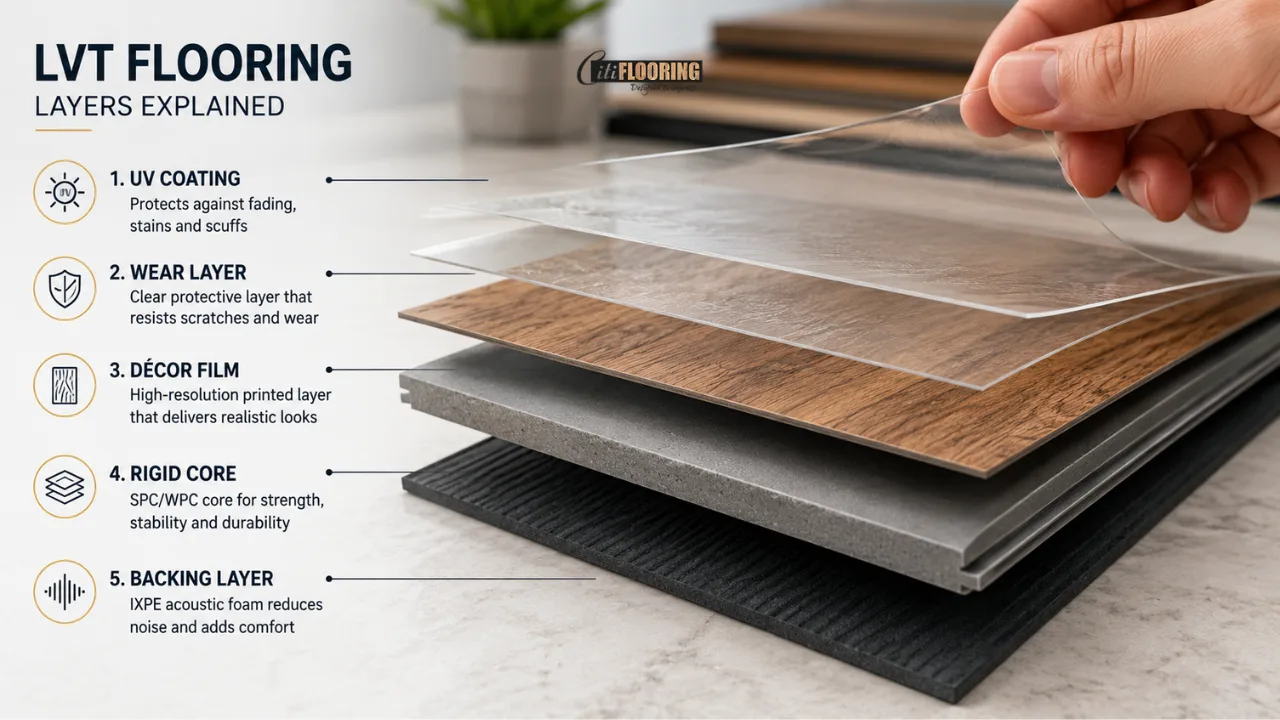
Modern LVT is engineered in five layers, and the quality of each one determines how long the floor will last and how good it will look in five years. Walk a homeowner through these layers and you will explain why the same-looking plank can cost S$3 or S$8 per square foot.
- UV coating, the topmost layer, applied as a UV-cured finish. It resists scuffs, sun fading, and stains. The thicker and more uniform the UV coat, the longer your floor keeps its original finish. In Singapore, where many flats face strong direct sunlight, UV coating quality is more important than most homeowners realise.
- Wear layer, measured in mils (one mil = 0.001 inch). This is the clear PVC layer that takes the scratches, dropped pans, dragged furniture, and pet claws. Residential LVT typically runs 12 to 22 mil; commercial-grade starts at 28 mil. For a Singapore family home with children or pets, 18 mil is the practical minimum.
- Décor film, the high-resolution print that creates the wood-grain, marble vein, or stone pattern. Quality LVT now uses embossed-in-register (EIR) printing, where the surface texture follows the print exactly. Run your hand across an EIR plank and you can feel the wood grain. Cheap LVT prints the texture flat and embosses a generic pattern on top, your eyes catch the mismatch even if your hands cannot.
- Rigid core, the structural backbone. This is where LVT splits into sub-categories: SPC cores are stone-plastic composite (denser, more rigid, fully waterproof), while WPC cores are wood-plastic composite (slightly softer, warmer underfoot, still waterproof). The core determines how the floor feels and how it handles minor subfloor imperfections.
- Backing layer, usually IXPE acoustic foam pre-bonded underneath. This is what stops the hollow-sound complaint that gave older click-lock floors a bad name. IXPE is cross-linked polyethylene, dimensionally stable in humidity, and significantly better at impact-noise dampening than the EVA foam that earlier generations of vinyl plank used.
If a supplier cannot tell you the wear-layer mil and the core type when you ask, that is your first red flag. Reputable Singapore suppliers print this on every spec sheet and have it available in writing on every quote. The combined thickness of all layers in a typical residential LVT plank is 4 to 6 mm, thinner than tile, thicker than sheet vinyl, and just right for an overlay installation over existing HDB tiles in many cases.
LVT vs SPC vs WPC vs Sheet Vinyl
These terms cause more confusion than any other in the flooring world. Different suppliers use them in different ways, and the marketing language often blurs the technical reality. Here is the honest breakdown.
| Type | Construction | Best For | SG Price (per sqft, supply) |
| LVT (umbrella) | Multi-layer with rigid or flexible core | All residential rooms; covers SPC and WPC | S$3.50 – S$12+ |
| SPC | LVT with stone-plastic core (rigid) | Wet zones, kitchens, high-traffic | S$3.50 – S$8 |
| WPC | LVT with wood-plastic core (warmer, softer) | Bedrooms, living, comfort-led spaces | S$5 – S$10 |
| Sheet Vinyl | Single roll, no rigid core | Budget renovations, rentals | S$1.50 – S$3.50 |
The headline: LVT is the umbrella; SPC and WPC sit underneath it as core variants. Sheet vinyl is a different product entirely, cheaper, less premium, glued down rather than clicked, and not what you want for a home you plan to live in for the next decade.
When a supplier markets LVT Core+ or another premium sub-brand, they are usually offering a refined version of one of these core types, better wear layers, better acoustics, better print resolution, and ideally, accessories like matching skirting that the generic imports do not stock.
If you are renovating an HDB and trying to choose between SPC and LVT (with WPC core), here is the simple rule. Use SPC where water is a daily reality, wet kitchen zones, near washing machines, in service yards. Use LVT with WPC core where comfort matters more, living rooms, bedrooms, study rooms. For most Singapore homes, mixing both across different zones is the right answer.
Why LVT Is Singapore’s Fastest-Growing Floor Choice
Five forces pushed LVT to the top of the Singapore flooring market between 2020 and 2026. Each one is rooted in a real concern that Singapore homeowners have wrestled with for decades.
- Climate fit, fully waterproof PVC core means it does not warp in our humidity the way real wood does. A Singapore renovation is essentially a stress test for any flooring material; LVT passes that test reliably.
- Comfort, the IXPE backing makes it softer underfoot than ceramic tile, with measurably better acoustics. Standing for 30 minutes in the kitchen feels different on LVT than on tile, and that difference matters for daily life.
- Speed, most HDB installations finish in 1.5 to 2 days, versus 5 to 7 days for tile hacking and re-laying. For families living in the home during renovation, the difference is not just convenience, it is one less week of dust, debris, and disrupted routine.
- Aesthetic range, modern EIR printing means your LVT can look like aged oak, white marble, polished concrete, or limewashed pine with surprising realism. Tile design has plateaued; LVT design has accelerated.
- Cost-to-look ratio, premium-looking LVT comes in well below real wood or marble, with lower ongoing maintenance costs. A marble-look LVT in your dining room delivers 90% of the visual impact of real marble at roughly 30% of the cost.
BTO owners, who make up a large share of Singapore renovations, took to LVT especially fast. Hacking the standard HDB tile is expensive, dusty, and time-consuming. LVT can be installed directly over existing tiles in many cases, cutting cost and time roughly in half. For a first-time homeowner balancing renovation budget against furniture and appliance spend, that trade-off is hard to ignore.
Interior designers and architects have shifted too. The major Singapore ID firms, the names you see featured on Qanvast and Hometrust, increasingly default to LVT for residential spec, with tile reserved for bathrooms and external balconies. That professional consensus has, in turn, normalised LVT for homeowners who might otherwise have hesitated.
LVT Core+, What Makes It Different
Citiflooring’s LVT Core+ is our take on what a premium residential LVT should be. We started with a few non-negotiables: thicker wear layer, real EIR texture, IXPE backing built into every plank, and, this is where most competitors stop short, exact-match skirtings and trims for every colourway.
The result is a floor that is HDB-approved, climate-tested for Singapore conditions, and designed to hold up against pets, children, and decade-long use. It comes in our most popular wood and stone looks, plus a herringbone H-Series for homeowners who want a feature pattern instead of straight planks.
If you compare spec sheets, Core+ sits in the upper-mid market, better than entry-level imported LVT, more accessible than imported European premium lines that cost S$10 to S$14 per square foot all-in. The trade-off is intentional. Most Singapore homes do not need a 30-mil commercial wear layer, but they do benefit from the matching skirting and a supplier who installs what they sell.
The matching-skirting detail deserves emphasis. More than 80% of competing suppliers in Singapore do not stock vinyl-wrapped skirting in colours that match their flooring. The result is that your premium LVT meets a generic white PVC skirting at the wall, and the visible mismatch undoes much of what you paid for. Core+ avoids this by sourcing skirting and trim alongside every flooring colourway.
Is LVT HDB-Approved?
Yes. LVT is HDB-approved for residential use across all flat types, provided installation follows two rules. First, you must have a valid renovation permit if any hacking, surface preparation, or skirting work is involved. Second, the installed floor needs to meet HDB’s impact-noise requirements, which is where the IXPE acoustic underlay matters.
For BTO and resale flats with existing ceramic tile, an LVT overlay is often the simplest route. The tile is left in place (after a level check), and the LVT clicks together on top with a thin underlay. This avoids the noise complaints, dust, and hacking debris that come with a full tile removal. HDB does not specifically require permits for overlay installations in most flat types, but always confirm with your installer based on your block’s renovation guidelines.
If you live in a condo, MCST rules may add their own working-hour constraints, but LVT itself is almost universally accepted by management corporations because it does not transmit impact noise to neighbours below. Some condo MCSTs explicitly require LVT or carpet (no tile) when renovating in stacked layouts; the IXPE backing is what makes LVT compliant.
LVT Flooring Price in Singapore
Pricing for LVT in Singapore in 2026 falls into three rough tiers. These are typical supply-and-install rates, material plus labour, including IXPE underlay, but excluding hacking, disposal, or special trims unless stated.
| Tier | Wear Layer | Price Range (per sqft) | Best Suited For |
| Entry | 12 mil | S$3.50 – S$5.00 | Rental units, short-stay flats |
| Mid (Core+ sits here) | 18–22 mil | S$5.00 – S$8.00 | Family HDB and condo homes |
| Premium | 22+ mil with EIR | S$8.00 – S$12.00 | Landed homes, design-forward condos |
For a 4-room HDB flat (around 900 sqft), expect total LVT costs of roughly S$4,500 to S$7,200 in the mid tier, including matching skirting and basic surface prep. Hacking existing tile, if needed, adds another S$1,500 to S$3,000 depending on the contractor and disposal route.
Condo pricing tends to land 10-20% higher per square foot for the same spec, partly because of MCST coordination requirements (lift bookings, working hours, common-area protection) and partly because condo homeowners often choose premium-tier finishes.
Watch out for quotes that look unusually low. The cuts almost always come from the wear layer, the underlay, or the skirting, three places where saving money now means rework in three to five years. A quote that comes in 25% below the typical mid-tier price is rarely a bargain; it is usually entry-tier material rebranded with a luxury label.
FAQ
Is LVT the same as vinyl flooring?
LVT is a premium subset of vinyl flooring. All LVT is vinyl, but not all vinyl is LVT. Sheet vinyl, for example, is also vinyl but lacks the multi-layer construction and rigid core that defines LVT. When you see a quote for ‘vinyl flooring,’ always confirm which type.
How long does LVT flooring last in Singapore?
Quality LVT with a 20-mil or thicker wear layer typically lasts 15 to 20 years in a residential setting. Singapore’s humidity actually suits LVT well because the PVC core does not absorb moisture. The factors that shorten lifespan are direct sunlight without UV protection on the glass, heavy furniture moved without felt pads, and rubber-backed mats trapping moisture against the surface.
Can I install LVT over my existing HDB tiles?
Yes, in most cases. As long as the tile surface is reasonably level (no broken tiles, no major lippage between tiles, no significant cracks) and not heavily damaged, LVT can be installed as an overlay. This saves time, cost, and the hassle of full tile hacking. A site survey before quotation will confirm whether overlay is feasible for your flat.
Is LVT safe for households with young children or pets?
Yes. Look for LVT certified phthalate-free and FloorScore or Greenguard Gold rated for low VOC emissions. Citiflooring’s LVT Core+ meets these standards. The surface is also softer underfoot than tile, which is gentler for falls and easier on pet joints. Cleaning up pet accidents is easier too, the seamless click joints do not collect liquid the way grout lines do.
What is the difference between LVT Core+ and standard LVT?
LVT Core+ is Citiflooring’s premium residential line. The key differences from generic LVT are a thicker wear layer (18-22 mil consistent), embossed-in-register surface texture across all colourways, IXPE acoustic backing pre-bonded on every plank, and exact-match skirting and trim availability, a finish detail most suppliers do not offer. The combined effect is a floor that looks finished, performs well in Singapore conditions, and ages gracefully.
Will LVT discolour from sun exposure?
Quality LVT with a UV-cured top coat resists fading well. Cheaper vinyl without proper UV protection can fade noticeably within a few years in west-facing rooms. Always confirm UV coating spec for any room with strong direct sunlight, and consider window film if your living room takes hours of afternoon sun.
How does LVT handle Singapore’s humidity over the long term?
Better than most alternatives. The PVC core does not absorb moisture, the click-joint design allows for thermal expansion, and the UV coating resists fade. Engineered wood and laminate are far more vulnerable to humidity damage in tropical climates. The most important step is the 48-hour acclimatisation period before installation, this lets the planks adjust to room temperature and humidity, which prevents joint gaps later.
| Ready to see and feel LVT Core+ in person? Drop by our showroom or request a free quote and our team will walk you through the wear layers, designs, and matching trims that fit your home. Explore the full LVT Core+ range at our brands: core luxury vinyl tiles. |
