

Vinyl tiles are one of the most widely recognised flooring formats in Singapore, and one of the most misunderstood. The term covers a product range that spans from the cheapest entry-level flooring available to luxury vinyl tile engineered for decades of residential service. Understanding what distinguishes one end of that range from the other is the most important step in choosing a vinyl tile product you will still be happy with five years from now.
What Are Vinyl Tiles?
Vinyl tiles are individual flooring units manufactured in tile shapes rather than plank shapes. They are part of the broader vinyl flooring category but distinguish themselves from vinyl sheet and vinyl plank products by their square or rectangular tile format, which is typically larger than a plank’s width dimension and designed to replicate the visual effect of stone tiles, ceramic tiles, or other masonry formats.
Vinyl tiles are composed of PVC (polyvinyl chloride) combined with various additives and reinforcement layers depending on the specification tier. At the entry level, vinyl tiles are thin (1.5 to 3mm), flexible, and typically installed with adhesive. At the premium level, vinyl tiles are the LVT (Luxury Vinyl Tile) format: thicker (4 to 5mm or above), dimensionally stable, often click-lock installed, and capable of convincingly mimicking natural stone, marble, or ceramic tile aesthetics.
In Singapore’s current renovation market, the most commercially relevant distinction within the vinyl tile category is between standard vinyl floor tiles, the thinner, adhesive-fixed format, and LVT, which is the premium category where visual quality, performance, and service life converge.
Vinyl Tiles vs Ceramic Tiles
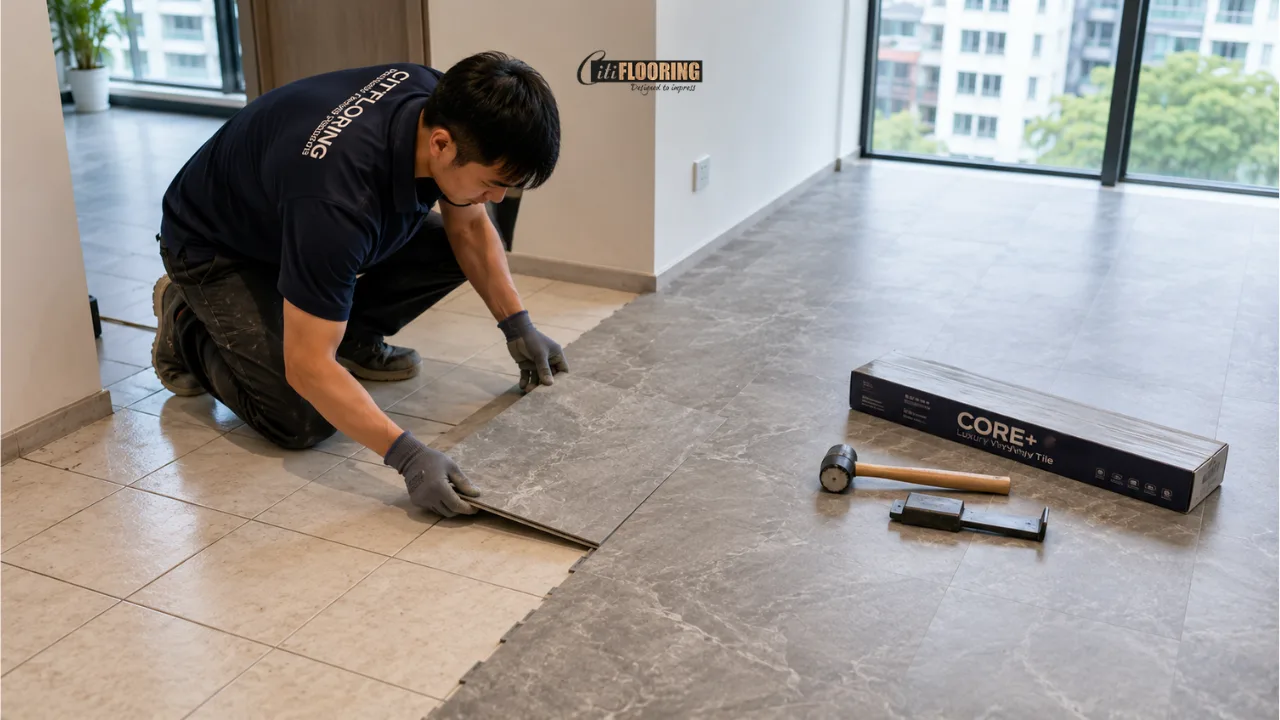
The comparison between vinyl tiles and ceramic tiles is one of the most practically significant decisions in Singapore home renovation, because the two formats compete directly for the same floor and wall spaces.
Ceramic and porcelain tiles are genuinely durable. Properly laid porcelain in a dry area can last fifty years or more. The disadvantages of ceramic tile in Singapore residential contexts are specific and consistent: it is hard and cold underfoot, requires hacking to remove or replace, transmits impact sound directly (a real concern in HDB multi-storey buildings), and its grout lines require periodic maintenance to prevent discolouration and biological growth.
Vinyl tiles address each of these concerns. They are softer and warmer underfoot than ceramic. They can be installed over existing ceramic tile without hacking. They do not transmit impact sound as efficiently as hard tile. Their surface has no grout lines to discolour or maintain. In Singapore’s humidity, vinyl tiles do not stain from the ground-in moisture that ceramic grout absorbs.
The ceramic tile holds its position where vinyl does not: in very high-heat commercial kitchen zones, in outdoor applications with heavy UV exposure, and in situations where absolute durability under the most extreme traffic loads is the primary criterion. For most Singapore residential applications, these conditions do not apply.
On cost, the direct material comparison between vinyl tiles and ceramic is competitive, but the no-hacking overlay advantage creates a meaningful total cost difference. A ceramic tile installation over an existing tile floor requires hacking (S$3 to S$5 per square foot), debris disposal (S$500 to S$1,200 for a full flat), subfloor levelling, and three to five days of active construction. A vinyl tile overlay over the same floor requires none of these costs and completes in one to two days.
Vinyl Tiles Price in Singapore
Standard adhesive vinyl tiles in Singapore typically cost S$2.00 to S$4.00 per square foot supply and install. This tier suits budget renovations, rental properties, and utility applications.
Mid-range vinyl tiles, including LVT in standard specification (0.3 to 0.5mm wear layer, click-lock), typically cost S$5.00 to S$8.00 per square foot supply and install.
Premium LVT such as CORE+ (5mm, 0.5mm wear layer, fiberglass-reinforced, EIR texture) in tile format (stone-effect designs) typically costs S$7.00 to S$10.00 per square foot supply and install.
For a reference calculation: a 4-room HDB flat with approximately 90 square metres of floor area costs S$7,000 to S$15,000 for mid-to-premium LVT tile format installation supply and install, inclusive of skirting.
Where Vinyl Tiles Work Best
Vinyl tiles are particularly effective in spaces where the floor is expected to read as stone, marble, or ceramic, but where the performance requirements of the actual material make natural stone impractical.
Living and dining areas where a stone-look floor creates the premium visual desired (rather than a wood-look) are the primary application. Large-format stone-effect vinyl tiles across an open-plan living room read as confident and refined, and the absence of grout lines in some formats creates a continuous surface that natural stone tiling cannot provide without specialist grout minimisation.
Kitchens are another strong application. Stone-effect vinyl tile in the kitchen provides the hygienic, water-resistant surface that the space demands while offering comfort underfoot and warmth that real ceramic does not. The absence of grout lines, or the minimal maintenance of vinyl-compatible grout in grouted installations, is a practical advantage in an area where floor hygiene is important.
Bathrooms suitable for fully waterproof LVT specification are a growing application. Stone-effect vinyl tile in a bathroom creates a convincingly luxurious aesthetic without the porosity, maintenance, and chip-risk of real stone.
How LVT Core+ Differs from Standard Vinyl Tiles
The difference between standard vinyl tiles and LVT like CORE+ is not cosmetic, it is constructional, and it matters for the service life and aesthetic quality of the installed floor.
Standard vinyl tiles use a simpler layer construction without dimensional reinforcement. They are more susceptible to expansion and contraction from temperature changes, which can cause joints to open or close visibly over time. The wear layer is typically thin (0.1 to 0.3mm), which means the protective coating degrades relatively quickly under foot traffic, exposing the print layer to physical damage. The surface texture is standard emboss rather than EIR, which means the visual realism is lower and the tactile experience does not reinforce the printed image.
CORE+ LVT in tile format uses a fiberglass-reinforced core that resists dimensional movement, a 0.5mm wear layer that provides substantially longer service life, and EIR emboss texture that aligns the physical surface with the printed stone or wood image. The result is a floor that looks more convincing, lasts significantly longer, and maintains its appearance more consistently across its service life.
Explore Citiflooring LVT Core+ in both wood-grain plank and stone-effect tile formats, and browse all flooring brands for a complete view of Citiflooring’s product range.
Frequently Asked Questions
Can vinyl tiles be grouted like ceramic tiles? Yes, with the appropriate LVT-compatible grout or sealant. Some homeowners prefer a grouted look for the stone-effect tile formats, as it enhances the realism of the installation. The grout lines in vinyl tile installations are maintenance-free compared with ceramic grout because the vinyl surface does not absorb moisture.
Are vinyl tiles slippery when wet? Quality LVT has a textured surface that provides slip resistance in normal wet conditions. CORE+ tile formats include emboss texture that adds grip to the surface. For bathroom installations where falls are a concern, tile format options with more pronounced texture are advisable.
How do I handle vinyl tile installation at doorways and transitions between rooms? Click-lock LVT tile format uses the same transition strips and threshold profiles as vinyl plank. These are available from Citiflooring to match the installed floor and create a clean, professional transition between rooms or between the LVT floor and carpet or ceramic tile in adjacent spaces.
Is there a minimum order quantity for vinyl tile formats? Standard residential orders are typically minimum one box quantities, which cover approximately 1.5 to 2 square metres depending on tile size. It is advisable to order 10 percent extra over the measured area to account for cutting waste and to have spare tiles for future repairs.
Conclusion
Vinyl tiles in Singapore range from a budget utility product to premium LVT that competes seriously with ceramic, porcelain, and natural stone on both aesthetics and performance. For serious residential renovations where the floor is expected to serve for fifteen or more years and deliver genuine visual quality, LVT Core+ in stone-effect tile format is the specification worth investing in. The gap between entry-level vinyl tiles and premium LVT is not just a quality difference, it is a service-life difference that changes the cost-per-year calculation significantly.
Browse our vinyl tiles Singapore gallery at citiflooring.com.sg/product. |
