

Vinyl flooring has become the dominant flooring choice for Singapore renovations, and it has earned that position. In a market where homeowners deal with high humidity, HDB noise regulations, tight renovation timelines, and a desire for the look of natural materials at practical cost, vinyl flooring checks boxes that tiles, laminate, and real wood cannot all check simultaneously.
But “vinyl flooring” covers a wide spectrum of products, from entry-level sheet vinyl to premium luxury vinyl tile, and understanding where different products sit on that spectrum is essential to making a choice you will be satisfied with for the next fifteen to twenty years.
Types of Vinyl Flooring in Singapore
Vinyl flooring in Singapore is available in three primary formats, each with distinct construction, performance characteristics, and price points.
Vinyl sheet flooring is sold in continuous rolls and glued to the subfloor. It is the most affordable vinyl format and is still used in utility areas, older HDB units, and commercial kitchens. Sheet vinyl has no joints across its surface, which makes it genuinely waterproof from edge to edge, but the installation requires adhesive, professional levelling of the subfloor, and results in a floor that cannot be removed without significant effort. Its visual quality is typically lower than tile or plank formats, and it does not achieve the realistic texture depth of modern LVT.
Vinyl plank flooring (LVP) is the most widely sold format in Singapore’s renovation market. It is manufactured in individual planks sized to mimic timber boards and installed either by gluing to the subfloor or, in modern systems, via click-lock mechanisms that require no adhesive. Click-lock vinyl plank can be installed floating over an existing floor without hacking, which is one of its defining commercial advantages in Singapore’s renovation context.
Luxury Vinyl Tile (LVT) is the premium category within the vinyl plank format. LVT is constructed with higher-specification layers than standard vinyl plank: a thicker wear layer, higher-definition printing, more sophisticated emboss texture, and often additional reinforcement layers such as fiberglass for dimensional stability. LVT is the format that delivers the most convincing wood and stone aesthetics, the best performance specifications, and the longest service life of the three vinyl categories.
Specialty vinyl types, including WPC (Wood Polymer Composite) and rigid core SPC (Stone Polymer Composite), are essentially evolved versions of LVT with modified core constructions that add rigidity and insulation. These are relevant for specific applications such as heated floors or very uneven substrates.
Why Vinyl Dominates Singapore Renovations
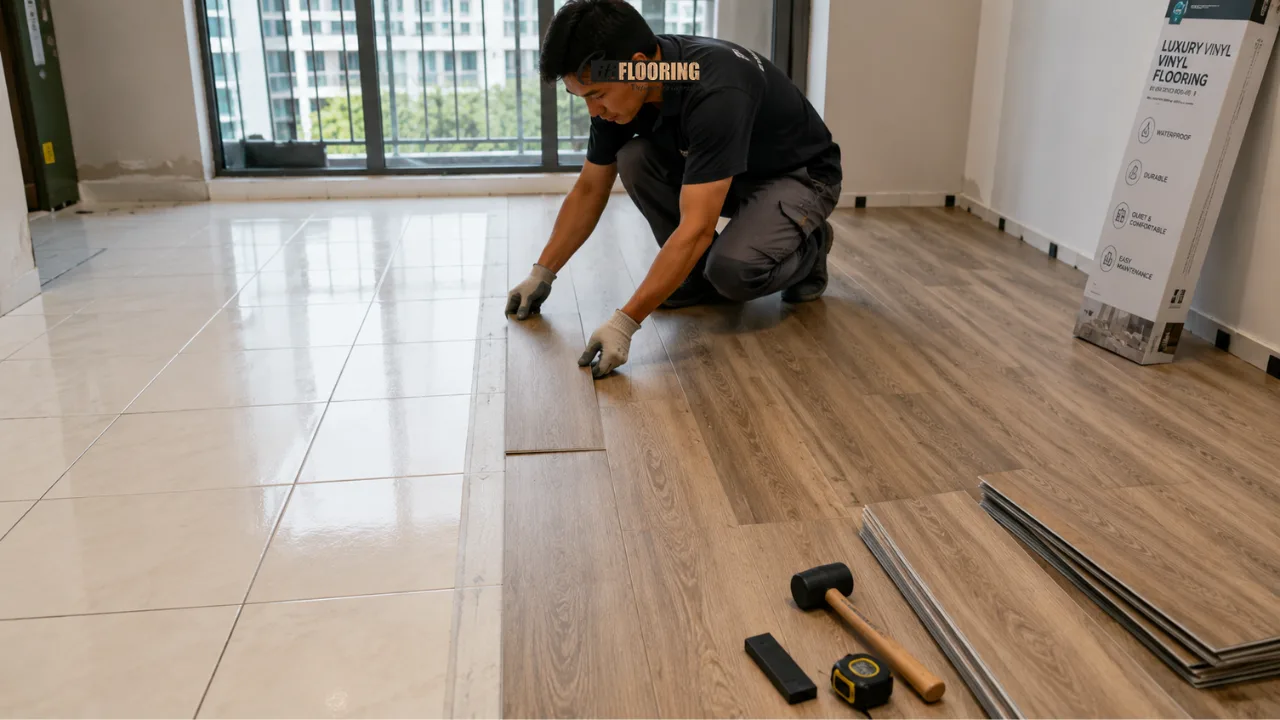
Vinyl flooring’s dominance in Singapore is not accidental, it is the product of the format fitting Singapore’s specific renovation conditions better than the alternatives.
The no-hacking overlay advantage is the single most commercially significant reason. Most Singapore homeowners renovating resale HDB flats or condo units face an existing tile floor. The choice is between hacking the old tiles out (cost: S$3 to S$5 per square foot for hacking plus S$2 to S$3 per square foot for debris removal, plus the time and disruption of a loud, messy process) or overlaying with vinyl (zero hacking cost, zero debris, completion in one to two days). For a 4-room HDB flat, this saves S$3,000 to S$5,000 on the renovation before any other comparison is made.
Waterproofing is the second reason. Singapore’s climate creates conditions where moisture is a persistent concern. Laminate flooring swells when exposed to sustained humidity or liquid spills. Natural wood requires careful moisture management. Quality LVT is 100% waterproof at the core: the plank does not swell, distort, or delaminate when exposed to moisture. In households with young children, pets, or wet area adjacency, this eliminates a category of risk that other flooring types carry.
Acoustic performance is the third. Singapore’s HDB noise regulations and the general expectation of acoustic consideration between floors make hard, impact-transmitting materials like tiles a source of tension with neighbours. Vinyl’s composite construction absorbs impact sound rather than transmitting it directly into the slab, making it a more considerate choice in multi-storey buildings.
Vinyl Flooring Price in Singapore
Vinyl flooring prices in Singapore vary across a range determined by the format, thickness, wear layer, brand, and installation conditions.
Entry-level vinyl sheet and glue-down vinyl plank typically costs S$2.50 to S$4.50 per square foot supply and install. This price range is appropriate for utility areas, rental properties, and applications where aesthetics are not the primary brief.
Mid-range click-lock vinyl plank and standard LVT typically costs S$4.50 to S$7.00 per square foot supply and install. This is the volume market in Singapore’s HDB renovation segment and includes products with adequate wear layer thickness (0.3 to 0.5mm) for normal residential use.
Premium LVT with 0.5mm or thicker wear layer, EIR texture, and reinforced core construction typically costs S$7.00 to S$12.00 per square foot supply and install. This range includes products designed for 15 to 20 or more years of residential service life.
For a 4-room HDB flat (approximately 90 square metres of floor area), total vinyl flooring supply and installation typically costs S$8,000 to S$17,000 depending on the product tier selected and the site conditions.
Additional costs to budget: skirting boards (S$2 to S$5 per linear metre), threshold strips between rooms, and disposal of packaging and protective materials.
Top Vinyl Brands in Singapore
Singapore’s vinyl flooring market includes both established international brands and strong local suppliers. The key differentiating factors between brands at a similar price point are wear layer thickness, core stability, surface texture quality, and after-sales support.
Citiflooring’s CORE+ LVT is positioned in the premium residential segment with a 0.5mm wear layer, fiberglass-reinforced core, Uniclic click-lock system, and EIR emboss texture across both wood and stone colourways. It is our top recommendation for most Singapore residential applications.
Other brands in the market include products from established names such as Polyflor, Evorich, and various direct import suppliers. Comparison across brands should focus on the actual specification, wear layer thickness, core construction, and warranty terms, rather than brand name alone.
Vinyl for HDB vs Condo
The distinction between HDB and condo applications affects which vinyl product specification is most appropriate.
In HDB units, the primary practical considerations are noise management (the HDB noise standard requires flooring materials to meet minimum Impact Insulation Class ratings), overlay compatibility over standard HDB tile formats, and the visual effect in the lower-ceiling, moderate-light conditions typical of HDB spaces. LVT performs well across all three: it absorbs impact sound, installs cleanly over HDB tile, and its colour range is specifically suited to maximising spatial quality in HDB interiors.
In condo units, the application range is broader. Better natural light, higher ceilings, and more variable interior design directions allow darker, more dramatically patterned LVT to perform effectively. The no-hacking overlay advantage still applies in condo resale units. New condo owners receiving bare concrete floors from developers will find that LVT installs directly over concrete with appropriate levelling compound, making it equally suited to new-build and resale applications.
In landed properties, the larger floor plates and multi-level structure make the lightweight, click-lock installation of LVT particularly practical. The waterproofing advantage is relevant across service yards, covered balconies, and the various wet-adjacent areas that landed homes contain.
How to Choose the Right Vinyl Flooring
Choosing the right vinyl flooring for a Singapore home comes down to answering four questions before shopping for specific products.
What performance level do you need? For the living room and bedrooms, standard residential LVT at 0.5mm wear layer is appropriate. For high-traffic areas, pet households, or areas with direct outdoor exposure, a thicker wear layer provides better long-term appearance retention.
What aesthetic direction do you want? The colour and pattern of the floor affects the entire room. Light tones expand space; dark tones create presence. Wood tones provide warmth; stone tones provide sophistication. Identify the interior direction before selecting a colourway.
What is the installation condition? Over existing tiles, flat concrete, or uneven substrate each requires slightly different preparation. An experienced supplier can assess your site and confirm the appropriate installation method.
What is your budget? The premium between entry-level vinyl and quality LVT is significant in percentage terms but moderate in absolute terms relative to the total renovation cost. For a floor that will serve for twenty years, upgrading to a quality product is a sound investment.
Why LVT Core+ Is Our Top Recommendation
CORE+ LVT represents the specification level where vinyl flooring delivers on all its performance promises: genuine waterproofing, convincing visual realism through EIR texture, dimensional stability through fiberglass reinforcement, and a 0.5mm wear layer that provides the service life appropriate for a significant renovation investment.
Explore Citiflooring LVT Core+ and view vinyl installations in completed Singapore homes. Browse our completed projects for real before-and-after context.
Frequently Asked Questions
Is vinyl flooring allowed in HDB flats? Yes. Vinyl flooring is one of the approved flooring types for HDB renovation. HDB’s renovation guidelines require flooring materials to meet minimum acoustic performance standards. Quality LVT from reputable suppliers meets these standards.
How long does vinyl flooring installation take? A typical HDB flat can be floored with click-lock LVT in one to two working days. The no-hacking overlay process significantly reduces installation time compared with tile replacement, which typically requires three to five days for hacking and re-tiling.
Can vinyl flooring be repaired if a plank is damaged? Yes. Click-lock vinyl plank can be individually replaced by unclipping and replacing the damaged plank, provided replacement stock from the same production batch is available. It is advisable to keep a small quantity of spare planks from the original purchase for this purpose.
Does vinyl flooring off-gas harmful chemicals? Quality LVT from reputable suppliers is formaldehyde-free and has low VOC emissions. CORE+ LVT is specifically certified as non-formaldehyde, making it safe for use in homes with children and sensitive occupants.
What is the difference between LVT and SPC flooring? LVT (Luxury Vinyl Tile) uses a flexible vinyl core, while SPC (Stone Polymer Composite) uses a rigid composite core that is denser and more resistant to heavy impact and concentrated loads. For most Singapore residential applications, quality LVT provides excellent performance. SPC is particularly suited to commercial applications and floors with significant weight-bearing requirements.
Conclusion
Vinyl flooring is the right choice for most Singapore homes in 2026, and LVT is the right category within vinyl. It installs without hacking, lasts two decades under normal residential use, looks convincingly like real wood or stone, and is easy to maintain in Singapore’s demanding climate. The questions that remain are which colour, which pattern, and which supplier, and those are considerably easier to answer once the category decision is made.
Browse our vinyl flooring gallery at citiflooring.com.sg/product. |
