

Pricing transparency is rare in Singapore’s flooring market, and it creates problems for homeowners who are trying to compare quotations without understanding what they are actually comparing. Two quotations for vinyl flooring of S$5 per square foot and S$9 per square foot are not comparable unless you know the product specifications, the installation scope, and the additional items each price includes or excludes.
This guide gives you the actual market rate information for vinyl flooring in Singapore in 2026, explains what drives cost differences across the spectrum, and identifies the additional cost items that frequently appear after the initial quotation is accepted.
Average Vinyl Flooring Price in Singapore
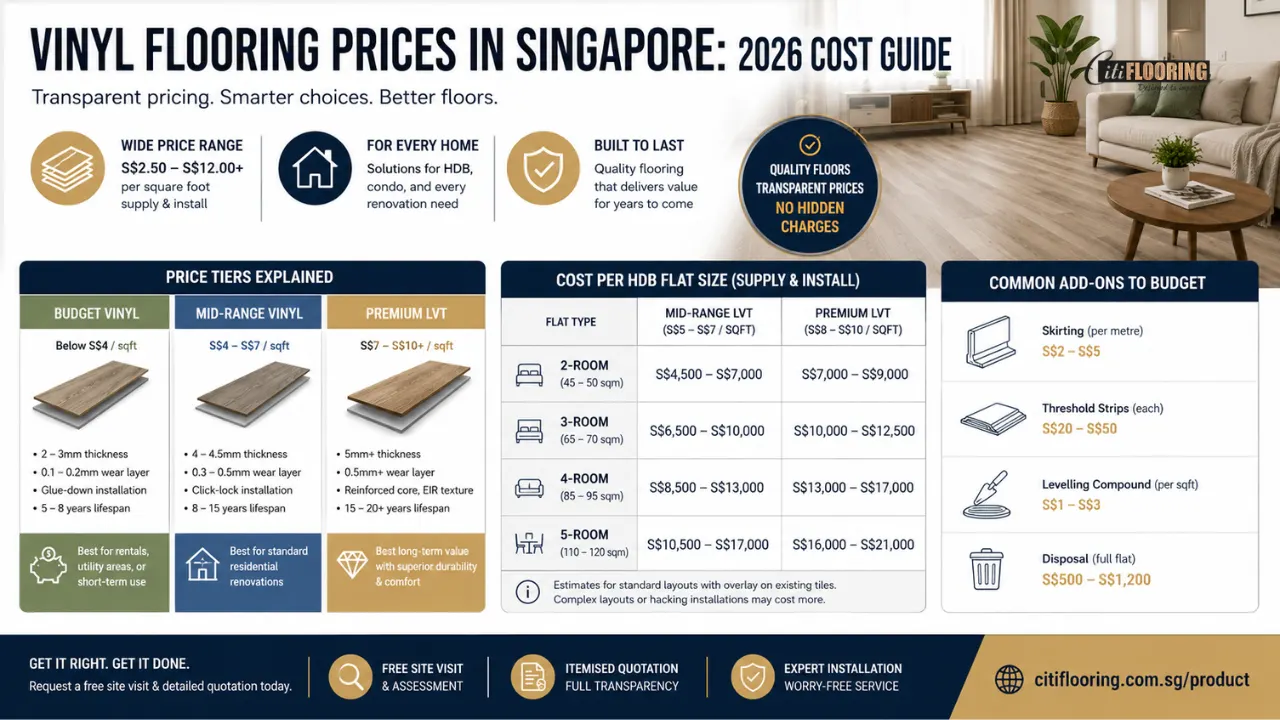
Vinyl flooring in Singapore covers a range from approximately S$2.50 to S$12.00 or more per square foot supply and install, depending on the product specification and the installation scope.
The most common renovation market range, mid-grade to premium LVT for an HDB or condo unit, sits between S$5.00 and S$10.00 per square foot supply and install. This is where the majority of Singapore’s residential vinyl flooring transactions occur, and it is the range within which product and installation quality vary most significantly.
Entry-level vinyl (thin glue-down plank or sheet) sits below S$4.00 per square foot supply and install. Premium commercial-grade LVT can reach S$12.00 to S$15.00 per square foot for high-specification products with very thick wear layers.
For a quick reference by flat type:
A 2-room HDB flat (approximately 45 to 50 square metres of floor area) at mid-range LVT specification typically costs S$5,000 to S$8,000 supply and install.
A 3-room HDB flat (approximately 65 to 70 square metres) at mid-range LVT specification typically costs S$7,000 to S$11,000.
A 4-room HDB flat (approximately 85 to 95 square metres) at mid-range LVT specification typically costs S$9,000 to S$14,000.
A 5-room HDB flat (approximately 110 to 120 square metres) at mid-range LVT specification typically costs S$11,000 to S$17,000.
These figures are for supply and standard installation only and assume overlay over flat, stable existing tiles. Additional items are discussed below.
Price Tiers: Budget, Mid-Range, and Premium
Understanding what differentiates the price tiers is more useful than knowing the price per square foot alone, because the differences affect the long-term value of the investment.
Budget vinyl (below S$4 per sqft supply + install): Typically 2 to 3mm thickness, 0.1 to 0.2mm wear layer, adhesive installation. Service life under normal residential use: five to eight years before visible wear. Suitable for rental properties, temporary installations, utility areas, and situations where the floor will be replaced within ten years.
Mid-range vinyl (S$4 to S$7 per sqft supply + install): Typically 4 to 4.5mm thickness, 0.3 to 0.5mm wear layer, click-lock installation. Service life under normal residential use: eight to fifteen years. Standard emboss texture rather than EIR. Suitable for standard residential renovation where mid-length service life is acceptable.
Premium LVT (S$7 to S$10+ per sqft supply + install): Typically 5mm or above, 0.5mm or thicker wear layer, fiberglass-reinforced core, EIR texture, click-lock installation. Service life under normal residential use: fifteen to twenty or more years. This is the specification tier where the cost-per-year-of-service calculation typically favours the premium product over time.
The cost-per-year analysis: a mid-range product at S$6 per square foot lasting twelve years costs S$0.50 per square foot per year. A premium LVT at S$9 per square foot lasting twenty years costs S$0.45 per square foot per year. The premium product costs less per year of service, even before accounting for the disruption and cost of replacing the floor two years earlier.
Cost Per HDB Flat Size
For practical budgeting purposes, the following table provides supply-and-install estimates for each common HDB flat type at mid-range and premium LVT specification in Singapore in 2026.
At mid-range LVT (approximately S$5 to S$7 per sqft): a 2-room flat costs approximately S$4,500 to S$7,000; 3-room flat S$6,500 to S$10,000; 4-room flat S$8,500 to S$13,000; 5-room flat S$10,500 to S$17,000.
At premium LVT like CORE+ (approximately S$8 to S$10 per sqft): a 2-room flat costs approximately S$7,000 to S$9,000; 3-room flat S$10,000 to S$12,500; 4-room flat S$13,000 to S$17,000; 5-room flat S$16,000 to S$21,000.
These estimates assume standard rectangular rooms with no significant obstacles. Complex room shapes with many cuts, installations around built-in furniture, and staircase installations carry premium over standard flat rate estimates.
Installation, Skirting, and Disposal Add-Ons
The additional cost items that frequently surprise Singapore homeowners after an initial quotation are consistent across the market and should be budgeted proactively.
Skirting: Skirting boards cover the gap at the perimeter of the floor where the floating installation terminates at the wall. Skirting is almost always an add-on cost, typically S$2 to S$5 per linear metre for standard skirting profiles. A typical HDB flat requires 60 to 80 linear metres of skirting. Budget S$150 to S$400 for skirting in a mid-range renovation.
Threshold strips: At doorways and room transitions, threshold strips create a finished edge between the vinyl and adjacent flooring. Each doorway typically costs S$20 to S$50 depending on the strip profile.
Levelling compound: Where the existing tile floor has significant surface variation, raised grout lines, lippage between tiles, or damaged tile surfaces, the installer may apply levelling compound before laying the vinyl. This adds S$1 to S$3 per square foot to the installation cost.
Disposal: If the old flooring is removed (uncommon in overlay installations), disposal of debris adds S$500 to S$1,200 for a full flat depending on debris volume.
Site visit and assessment: Reputable suppliers typically offer a free site visit to assess the existing floor, confirm the installation method, and provide an accurate quotation. This assessment prevents surprises during installation.
How to Avoid Hidden Charges
Hidden charges in vinyl flooring quotations follow predictable patterns that can be addressed before the contract is signed.
Ask for an itemised quotation that separates material cost, installation cost, skirting, threshold strips, and any provisional sum items. A lump-sum quotation does not allow you to understand where the cost is concentrated or to compare like-for-like with competing quotes.
Confirm whether the quoted price is for supply and install or supply only. Some suppliers quote material price per square foot and add installation separately; others quote a combined supply-and-install rate. Comparing the two without adjustment produces a misleading price comparison.
Confirm the installation method, overlay versus hacking, and verify that the quotation assumes the correct method for your floor condition. A quotation assuming hacking will be significantly higher than one assuming overlay, and vice versa.
Ask specifically about what happens if the installer discovers an issue during installation that requires additional work, such as a cracked tile that must be stabilised before overlay can proceed. A good supplier will include a provisional sum for this and confirm the rate at which any out-of-scope work will be charged.
View LVT Core+ pricing, learn about our supply and install service, and request a quote from Citiflooring with full itemisation and no hidden charges.
Frequently Asked Questions
Why do vinyl flooring prices vary so much between suppliers for the same type of product? Prices vary because product specifications that sound similar are often meaningfully different. A 5mm vinyl plank with a 0.3mm wear layer costs less to manufacture than the same thickness with a 0.5mm wear layer, but is marketed using the same general description. Always request wear layer thickness in writing.
Is a lower price always a sign of lower quality? Not always. Direct importers and brands with lower marketing costs can sometimes offer competitive prices for quality products. The specification, wear layer, core construction, texture quality, is the relevant variable, not price alone.
Does the quotation include removal of the old floor? Only if the installation method requires hacking. For overlay installations, which are the standard approach for most Singapore HDB and condo renovations, the old floor is not removed and there is no disposal cost.
How do I compare quotations from different suppliers fairly? Create a specification checklist: total thickness, wear layer thickness, core construction (standard or reinforced), surface texture (standard emboss or EIR), installation method (click-lock or glue-down), skirting included or excluded, and warranty terms. Compare quotations against this checklist rather than against the per-square-foot price alone.
Conclusion
Vinyl flooring prices in Singapore in 2026 reflect a market with significant quality variation within each price tier. The homeowner who understands what drives cost differences, wear layer thickness, core construction, texture quality, can make a product choice based on actual specifications rather than price alone. At the premium tier, quality LVT like CORE+ delivers a cost-per-year-of-service that frequently beats mid-range alternatives when evaluated over the full service life of the floor.
Browse our vinyl flooring prices gallery at citiflooring.com.sg/product. |
