

Five years ago, ceramic tile was the default for almost every Singapore living room. Three years ago, SPC took the spotlight. In 2026, LVT, and specifically LVT Core+, is what most interior designers in Singapore now spec by default for residential homes.
That is not just a fashion shift. It is a response to climate, lifestyle, and renovation economics. The people choosing LVT today are not chasing a trend; they are weighing a real-world list of priorities, comfort, acoustic performance, install speed, design flexibility, long-term cost, and arriving at the same conclusion. LVT, when specified properly, simply does the job better than the alternatives for the majority of Singapore homes.
This article explains the why, addresses the trade-offs honestly, and describes where Citiflooring’s LVT Core+ fits in for the average Singapore homeowner.
Why LVT Has Overtaken Tile and SPC in Singapore
If you compare the renovation magazines and Qanvast features from 2021 to 2026, the shift is hard to miss. Tile-heavy interiors gave way to wood-look LVT in living rooms. SPC, which had a strong run as the rigid waterproof option, started losing share to LVT in non-wet areas because LVT simply feels better underfoot.
Three reasons drive the shift. First, LVT installs faster, usually 1 to 2 days for an HDB flat, versus a week for tile. Second, LVT solves the noise problem that condo MCSTs and HDB neighbours had with the older click-lock floors that lacked proper acoustic backing. Third, modern EIR printing made wood-look and stone-look LVT indistinguishable from the real thing in photos, and very close in person.
Tile still wins in fully wet zones, bathrooms with floor drains, balconies exposed to rain. But for everywhere else, LVT now reads as the practical default. Ask any renovation contractor in Singapore and they will tell you the same thing: ten years ago they laid tile in nine out of ten flats; today, those same flats get LVT in the living room and bedrooms, with tile reserved for bathrooms and the kitchen wet area.
The professional consensus matters. Interior designers, when given the choice, increasingly spec LVT because it gives them more design freedom (wider plank widths, herringbone formats, stone-look tiles) without forcing the homeowner into expensive material territory.
LVT Core+, Citiflooring’s Take on Premium LVT
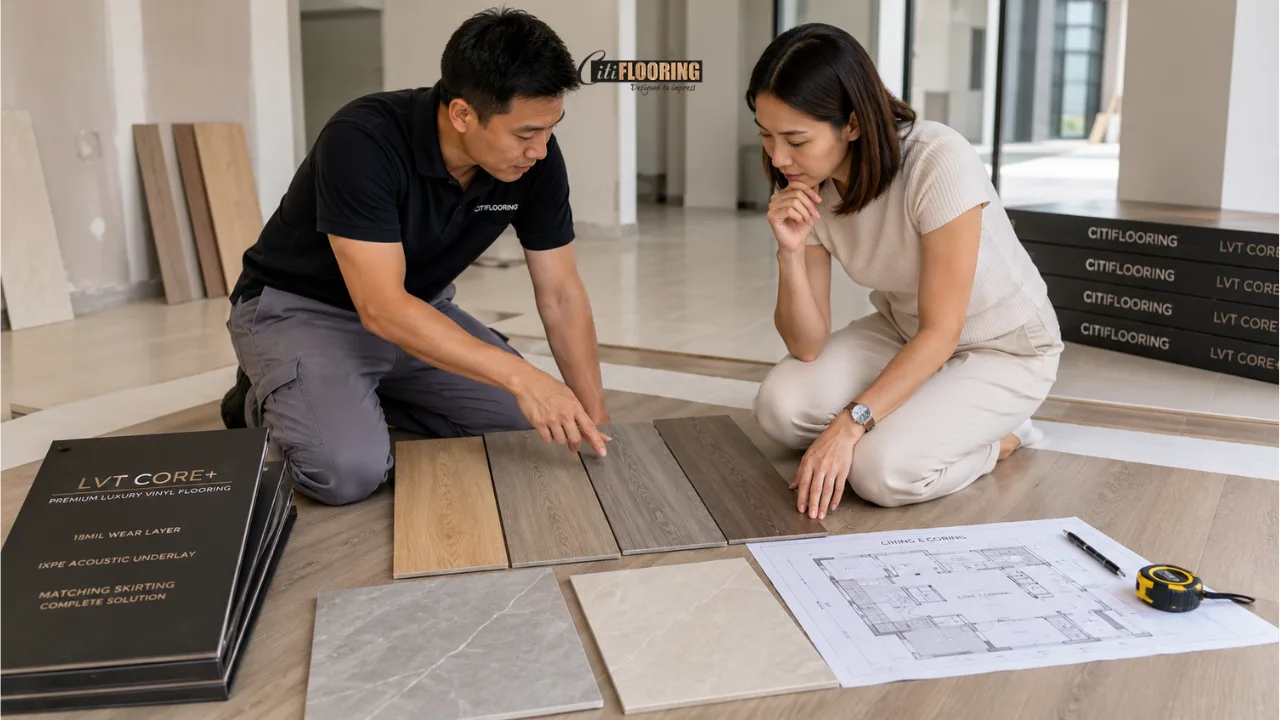
We built LVT Core+ around three principles. The wear layer should be 18 mil or above, enough for a decade of family use. The acoustic underlay should be IXPE, pre-bonded, on every plank, no separate loose underlay that sometimes shifts during installation. And every colourway should ship with an exact-match skirting available off the shelf.
That last point sounds minor. It is not. Mismatched skirting is the single most common detail that makes a premium floor look cheap. More than 80% of suppliers in Singapore do not stock matching vinyl-wrapped skirting, so renovation contractors substitute generic white PVC skirting. The floor looks beautiful; the edges look like an afterthought. Walk into any Citiflooring showroom and you will see the difference immediately when you look at the wall-to-floor transition.
Core+ ships with herringbone, classic plank, and stone-tile formats. Each has its own intended room and aesthetic. We will recommend a format for your home, but we never push one product. The H-Series herringbone designs are particularly popular in 2026, H5520 Herringbone Maple, H5505 Herringbone Muji, H2026 Brown Ash, and H2021 Cherry Oak. Each one suits a different design palette.
The full Core+ range includes wood-look colourways from light Scandinavian (C5505 Muji) through warm oak (C2024 Gentle Oak) to deeper tones (C3034 Mahogany) and dark accents (C4111 Dark Ash). For homeowners who prefer stone over wood, the CT-series stone-effect tiles, CT7030 Greystone, CT7020 Silver Slab, CT7010 Moonstone Grey, CT1820 Cotton Beige, give the marble-look at LVT prices.
LVT Performance in Singapore’s Climate
Singapore is hard on flooring. Sustained 75 to 85% humidity, year-round air conditioning that creates thermal cycling, occasional flooding incidents, and strong direct sunlight in west-facing flats. A floor needs to handle all of it without warping, fading, or developing gaps.
LVT’s rigid PVC core does not absorb moisture, so dimensional stability holds up where engineered wood and laminate often fail. Walk into a 10-year-old condo with engineered wood and you will frequently see edge gaps where humidity cycling has shifted the boards. LVT does not have this problem because PVC simply does not absorb water.
The UV coating prevents the colour fade that affects cheaper vinyl near windows. This matters more than most homeowners realise, a west-facing Singapore living room can take 4-6 hours of intense sunlight per day, and unprotected vinyl can fade noticeably within 18 months. Quality LVT with a UV-cured top coat resists this for 10-15 years.
Because the planks click and float, small movements from thermal expansion are absorbed without buckling. We still recommend a standard acclimatisation period, leaving the planks unboxed in the room for 48 hours before installation, so the material settles to the room’s temperature and humidity. Skipping this step is the most common cause of click-joint issues in Singapore installations, and it is one of the first things our installers verify before starting work.
Common Singapore Use Cases (HDB, Condo, Landed)
LVT works across every Singapore housing type, but the ideal spec varies. Here is how we typically advise homeowners depending on their flat type.
- HDB BTO, overlay LVT directly on existing tiles where possible. Mid-tier 18-mil Core+ in a warm oak colourway works well in family flats. Budget S$5,500 to S$8,000 for a 4-room flat including matching skirting. The overlay approach also avoids hacking permit complications.
- Resale HDB, depending on existing floor condition, you may need to hack and re-screed, or you may be able to overlay. A site survey will tell you. For larger 5-room and executive flats, herringbone patterns add visual depth without raising material cost much. We often recommend the H-Series for resale homeowners who want a clear visual upgrade.
- Condo, premium 22-mil Core+ with stone-look or wide-plank wood-look. Match the skirting precisely. Some MCSTs require LVT specifically because of their no-tile renovation rules in stacked layouts. For condo renovations, MCST coordination (lift bookings, working hours, common-area protection) adds 1-2 days to the installation timeline.
- Landed, split the spec by area. Living and bedroom areas in 22-mil wood-look or herringbone; service areas in SPC or higher-mil LVT. Use marble-look LVT in dining areas where you want the look of stone without the maintenance. For staircase areas, ensure stair nosing is specified in the matching colour.
One detail that varies across all four cases: the right plank width. HDB rooms benefit from standard 7-inch planks because they make smaller spaces feel proportionate. Condo and landed homes with bigger living areas can carry wider 9-inch planks, which create a more luxurious look in larger rooms. We adjust the recommendation based on actual room dimensions during the site survey.
LVT Price vs Other Floors
Where does LVT sit on the price ladder, all-in (material plus install)? Here is the rough 2026 Singapore market view, per square foot:
| Floor Type | Typical Range (S$/sqft) | Notes |
| Sheet vinyl | S$2.50 – S$4.00 | Budget, rentals only |
| Laminate | S$3.50 – S$6.00 | Not waterproof, weaker in SG humidity |
| SPC | S$4.50 – S$7.00 | Rigid waterproof core, harder underfoot |
| LVT Core+ (mid) | S$5.50 – S$8.00 | Citiflooring’s residential default |
| Engineered wood | S$10.00 – S$18.00 | Real wood, premium look, climate-sensitive |
| Solid hardwood | S$15.00 – S$30.00 | Premium only, not recommended for HDB |
| Marble tile | S$12.00 – S$25.00+ | High maintenance, sealing required |
On a price-to-look ratio, LVT Core+ delivers wood-look or marble-look results at roughly half the cost of the real material, and with significantly less ongoing maintenance. Real wood needs occasional sanding and resealing; real marble needs sealing every 1-2 years and is vulnerable to acid stains from fruit juice and wine. LVT requires neither.
When you factor in the matching skirting (typically S$8-12 per linear metre supplied and installed), the total cost for a 4-room HDB Core+ installation lands in the S$5,500 to S$8,000 range. That is significantly less than engineered wood (S$10,000-15,000 for the same flat) and competitive with mid-tier tile renovations once hacking is included.
How to Buy LVT in Singapore
If you are starting your LVT shopping, run through this five-step process before signing anything. Each step protects you from a different kind of problem we see homeowners encounter post-installation.
- Visit a showroom and physically touch the wear layer. Print fidelity and texture realism only show up in person, not in catalogue photos. Take a sample home and look at it in your room’s actual lighting before deciding.
- Ask for the wear-layer mil number in writing. Anything below 18 mil for a family home is a downgrade. If the salesperson hesitates or quotes a range instead of a number, that is a signal.
- Confirm the IXPE underlay is bonded to every plank. If it ships separately, you risk shifting during installation and inconsistent acoustics. Bonded IXPE is more expensive at the factory but cheaper for you over time.
- Ask whether matching skirting is in stock for the colourway you choose. If the answer is ‘we will use white PVC,’ your premium floor will not look premium when finished. Ask to see a physical sample of the skirting alongside the floor.
- Confirm who installs. A supplier that installs what they sell takes accountability for the finish. If installation is sub-contracted blindly, the warranty often becomes a finger-pointing exercise when issues appear. Ask whether the installation team is in-house and how long they have worked with the supplier.
FAQ
Why is LVT more popular than SPC in Singapore now?
LVT feels better underfoot than SPC because of the integrated IXPE backing and slightly softer core. For non-wet residential areas, that comfort difference matters. SPC remains the better choice for kitchens, bathrooms, and commercial wet zones where rigidity and waterproofing matter most.
Is LVT Core+ a separate brand or just a line within Citiflooring?
LVT Core+ is Citiflooring’s house line of premium residential LVT. We control the spec, wear layer, core, EIR texture, IXPE backing, and matching skirting, so the quality is consistent and the install comes from the same team. It is not a re-labelled import; the spec is set by us based on Singapore renovation requirements.
How does LVT handle Singapore’s humidity over the long term?
Better than most alternatives. The PVC core does not absorb moisture, the click-joint design allows for thermal expansion, and the UV coating resists fade. Engineered wood and laminate are far more vulnerable to humidity damage in tropical climates. We have installed Core+ in flats from 2018 onwards with no humidity-related complaints.
Will LVT discolour from sun exposure?
Quality LVT with a UV-cured top coat resists fading well. Cheaper vinyl without proper UV protection can fade noticeably within a few years in west-facing rooms. Always confirm UV coating spec for any room with strong direct sunlight, and consider window film for extreme exposure (4+ hours of daily direct sun).
How long does LVT installation take for an HDB flat?
A 4-room HDB typically takes 1.5 to 2 working days for LVT supply and install when overlaying existing tile. If hacking is required, add another 2 to 3 days for hacking, screeding, and curing before LVT can be laid. The overall timeline shrinks if you bundle floor and skirting under one vendor, there are fewer hand-offs and less coordination friction.
Can I mix different LVT colourways in different rooms?
Yes, and this is increasingly common in Singapore homes. Many homeowners choose a warm oak for living and dining, a slightly darker tone for bedrooms (better for nap-time light control), and stone-effect LVT for kitchens or bathrooms. The key is to match the skirting to the dominant floor in each room and to plan transition strips at doorways.
| Considering LVT for your renovation? Visit our showroom to see and feel the LVT Core+ range, including matching skirting and the herringbone H-Series. Or request a free site survey and quote at contact us citiflooring.com.sg. |
