

“Cheap vinyl flooring” is the most searched flooring category in Singapore for a reason: renovation budgets are real, and the desire for a floor that looks good at a price that works is entirely reasonable. The problem is that “cheap” in the flooring market covers two genuinely different things, products that offer good value at a lower price point, and products that cut specification corners to hit a number that will cost you more over the life of the floor.
Understanding which is which before you buy is the only way to shop this category without regret.
Why “Cheap” Doesn’t Always Mean Bad Value
Cheap vinyl flooring is not automatically poor vinyl flooring. Several factors can make a lower-priced product represent genuine value.
Direct import suppliers with lower marketing and distribution overhead can offer competitive prices on quality products because their cost structure is leaner than established brands with heavy retail infrastructure. If the specification is sound, wear layer at 0.5mm, fiberglass-reinforced core, click-lock installation, the product may be genuinely good value regardless of its unknown brand name.
Simpler design ranges cost less to manufacture than complex multi-colourway collections with extensive colour development. A supplier offering a focused range of five or ten well-chosen designs can price more competitively than one maintaining a fifty-design catalogue with constant new colourway development costs.
Promotional pricing on specific colourways, end-of-batch runs, discontinued designs being cleared, can deliver premium specification at budget prices. The product is the same; the commercial motivation for the low price is stock management rather than specification reduction.
These are legitimate reasons why price does not always track quality. The challenge is that the same price can also reflect genuine specification reduction that will cost you in service life.
Five Red Flags in Cheap Vinyl Flooring
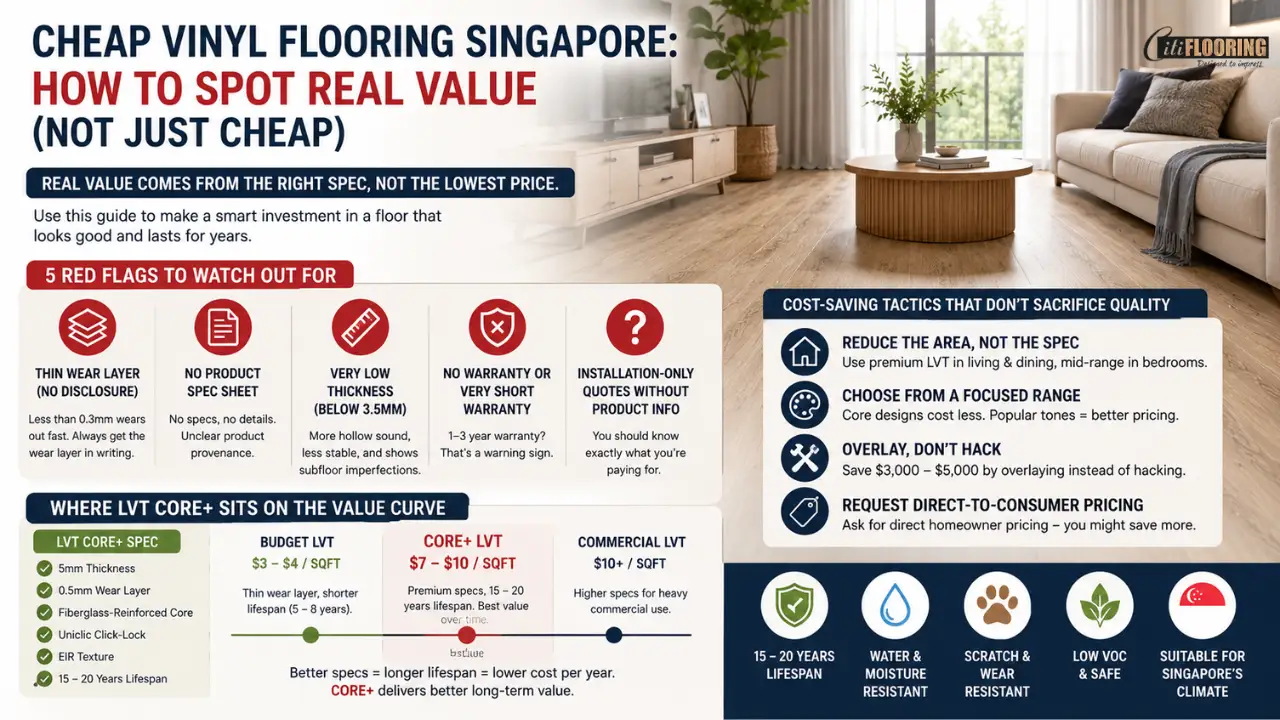
When evaluating a very low-priced vinyl flooring quotation in Singapore, five specific signals should prompt closer scrutiny before purchase.
Thin wear layer without disclosure. A wear layer of 0.1 to 0.2mm is the most common specification reduction in budget vinyl. At this thickness, the protective coating over the print degrades under normal residential foot traffic within three to five years, exposing the design layer to physical damage. The red flag is when a supplier quotes per square foot without volunteering the wear layer thickness, or becomes evasive when you ask. Always get the wear layer thickness in writing before committing.
No product specification sheet. Reputable suppliers can provide a technical specification sheet for their vinyl product covering thickness, wear layer, core construction, installation method, fire rating, and warranty. A supplier who cannot produce this documentation for their product is a supplier whose product provenance is unclear.
Very low thickness (below 3.5mm). Thin vinyl plank is more susceptible to telegraphing subfloor imperfections, more likely to produce hollow sound in floating installation, and less dimensionally stable in Singapore’s temperature range. Products advertised as vinyl plank below 3.5mm total thickness are typically entry-level products inappropriate for main living areas.
No warranty or very short warranty. Quality LVT comes with a warranty of ten to twenty years for residential use. A product offered with a one to three year warranty reflects the supplier’s own assessment of the product’s service life expectation. This is the most direct indicator of the manufacturer’s confidence in what they are selling.
Installation-only quotations without product identification. A quotation that says “vinyl flooring supply and install” without naming the specific product, manufacturer, and specification leaves you no basis for understanding what you are buying until it is on your floor.
Cost-Saving Tactics That Don’t Sacrifice Quality
Reducing the cost of a vinyl flooring renovation without reducing the quality of the product requires working on the right variables.
Reduce the area, not the specification. If budget is tight, consider applying premium LVT only to the living and dining areas, the primary aesthetic zones, and using mid-range LVT in bedrooms where the visual impact is lower and traffic is lighter. This preserves quality in the areas that matter most without compromising the specification in those areas.
Choose from a focused range. Complex or unusual colourways cost more because the print development and production run costs are higher. The core range of popular natural wood tones and grey neutrals is typically priced more efficiently because the production volume is higher. Choosing Maple over a specialty colourway in the same product line often costs less for the same specification.
Overlay, don’t hack. The no-hacking overlay installation saves S$3,000 to S$5,000 on a full HDB flat renovation compared with hacking and relaying tiles. Applying this saving to upgrading the vinyl specification is a more effective renovation decision than hacking the floor and buying cheaper vinyl.
Request direct-to-consumer pricing. Some Singapore suppliers serve both trade (interior designers, contractors) and retail (direct homeowners) channels at different price structures. Asking explicitly whether a better price is available for a direct homeowner purchase occasionally unlocks pricing that is not advertised.
Where LVT Core+ Sits on the Value Curve
CORE+ LVT is not the cheapest vinyl flooring in Singapore’s market, and it is not positioned to be. At S$7 to S$10 per square foot supply and install, it sits in the premium residential tier, above the volume budget products but below the specialist commercial specifications that carry significantly higher cost.
Its position on the value curve reflects the specification it delivers: 5mm thickness, 0.5mm wear layer, fiberglass-reinforced core, Uniclic click-lock, EIR texture, and a service life expectation of fifteen to twenty years. At S$8 per square foot and twenty years of service, the cost per year is S$0.40 per square foot. At S$4 per square foot for a budget product lasting eight years, the cost per year is S$0.50 per square foot. CORE+ is the better value by this measure, despite the higher initial price.
The Singapore-specific risk factors that budget vinyl fails to address also reinforce the case for premium specification. Humidity in Singapore’s residential environment can cause plastic plasticiser migration in low-quality PVC products, a process by which chemical compounds used to soften the vinyl migrate to the surface, creating a tacky residue and causing the plank to bond with itself or adjacent surfaces. Quality vinyl with properly formulated PVC compound does not exhibit this behaviour. The risk is invisible in a showroom but visible within two to three years in a poorly-specified installation.
Explore value-tier LVT Core+ and learn about our supply and install bundle for a complete project price.
Frequently Asked Questions
Is there a minimum price below which vinyl flooring is definitely not worth buying? As a general guide, LVT below S$4 per square foot supply and install in Singapore should be scrutinised carefully for specification. At that price level, the product is likely to be thin (below 4mm), with a thin wear layer (0.2mm or below), and without dimensional reinforcement. It may be appropriate for a utility area or a rental property; it is not the right choice for a primary living space expected to perform for fifteen years.
How do I verify that the wear layer thickness stated is accurate? Request the product’s technical data sheet or certification documentation. Legitimate manufacturers can provide SGS or equivalent testing certificates that confirm the wear layer thickness. A supplier who cannot produce testing documentation for the wear layer specification is a supplier whose claim cannot be verified.
Are there Singapore-specific risks with low-quality vinyl that don’t apply in other markets? Yes. Singapore’s heat and humidity accelerate chemical processes that lower-quality PVC formulations are more susceptible to, including plasticiser migration, colour shift from UV exposure in naturally lit spaces, and dimensional instability from temperature variation between air-conditioned and non-air-conditioned conditions. Premium LVT formulations are tested for stability in these conditions; budget products often are not.
Is it safe to buy the cheapest vinyl if I am going to resell the property within a few years? If the property will be sold within three years and the floor will not deteriorate visibly in that time, a budget product may be technically sufficient for the purpose. The risk is that obvious wear or quality issues in a very cheap installation may be visible to buyers and affect the property’s perceived renovation quality at sale.
Conclusion
Cheap vinyl flooring in Singapore is not always a bad deal, but distinguishing genuine value from specification-cutting requires knowing what to look for. Wear layer thickness, product documentation, warranty terms, and supplier transparency are the filters that separate products that perform from those that merely appear competitive. The best value in vinyl flooring is not the lowest price per square foot, it is the lowest cost per year of service from a floor you are happy with every day you live on it.
Browse our vinyl flooring gallery at citiflooring.com.sg/product. |
