

Buying luxury vinyl tile in Singapore in 2026 is harder than it sounds. Every supplier calls their product luxury. Every quote uses the same vocabulary, wear layer, EIR, IXPE backing, but the actual specs vary wildly. And the price can swing 3x for what looks like the same thing in the showroom photo.
This buyer’s guide is built for the homeowner who wants to understand the spec sheet before signing. We will walk through what the word luxury actually buys you, how to read a wear-layer number honestly, where prices land in 2026, and which suppliers are worth shortlisting. The goal is to give you a buyer’s checklist you can use anywhere, not just at our showroom, so you walk into your renovation decision with clear eyes.
What ‘Luxury’ Means in LVT (Spec Breakdown)
Luxury in LVT is not a marketing term, it has technical meaning. To be sold as luxury vinyl tile, a product needs three things at minimum: a wear layer (rather than just a clear coat), a printed décor film with realistic texture, and a rigid or semi-rigid core (rather than just a flexible vinyl sheet).
What separates premium from mid from entry within the luxury category is the depth of each of those three layers. A 12-mil wear layer is luxury. A 22-mil wear layer is also luxury. They cost very different amounts and last very different lengths of time. The word alone does not tell you which you are buying.
There are also marketing flourishes that do not change the underlying product. ‘Premium engineered LVT’ usually means the same thing as ‘LVT.’ ‘Hybrid plank flooring’ is typically WPC-core LVT. ‘Stone polymer composite’ is just SPC by another name. Always look past the label and ask for the spec sheet, wear layer in mils, core type in plain language, IXPE thickness in millimetres, and total plank thickness.
Reputable Singapore suppliers print all of this on every product card. If a supplier hesitates to share the spec sheet or gives you a vague answer like ‘our LVT is high-quality imported,’ treat that as a signal. Premium products have measurable specs and the suppliers behind them are happy to publish those specs.
Wear Layer, Core, and Backing, What to Check
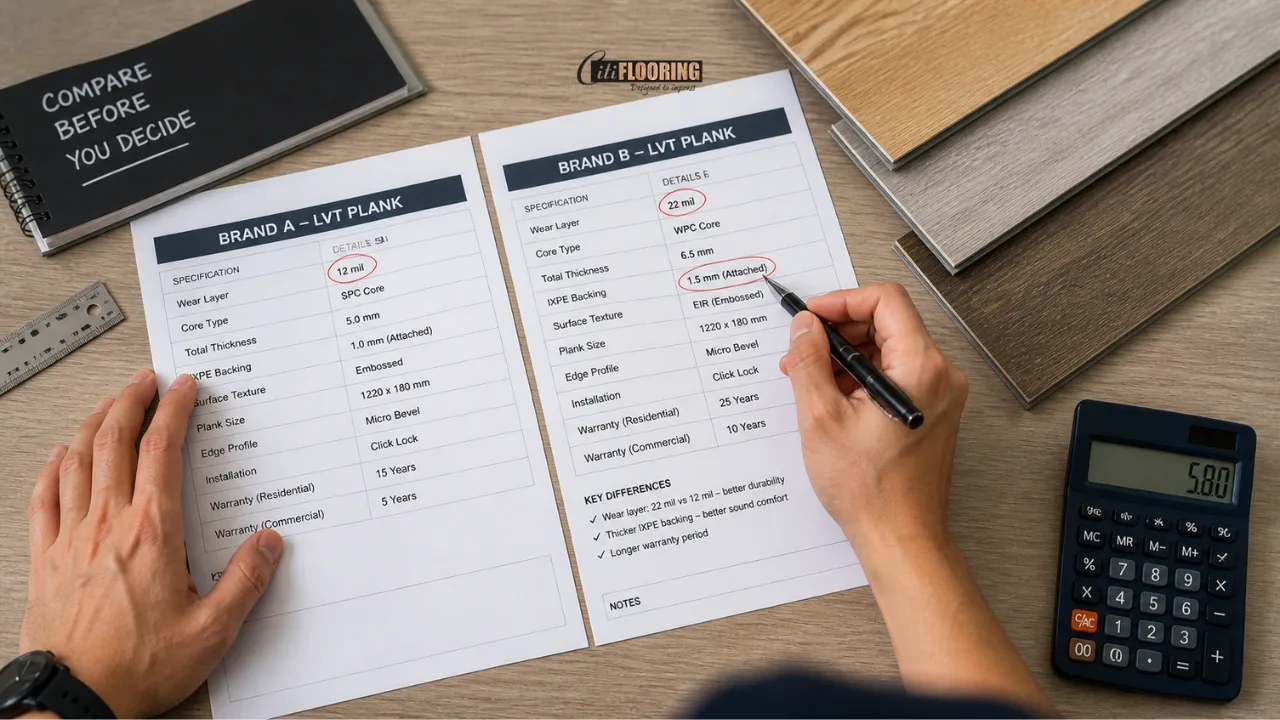
Three numbers determine whether your LVT will hold up. Read them carefully on every quote and compare them like you would compare phone specs.
- Wear layer (mil): 12 mil = light residential, 18-22 mil = family residential, 28+ mil = commercial. For a Singapore family home with pets or children, 18 mil is the minimum we recommend. The wear layer is the single most important spec, it determines how the floor ages over a decade.
- Core type: SPC (stone-plastic) is rigid and waterproof; WPC (wood-plastic) is slightly softer and warmer. LVT Core+ uses a refined SPC core for residential use, with the IXPE backing providing the comfort layer that pure SPC tends to lack.
- Backing: IXPE cross-linked polyethylene is the gold standard for acoustic underlay. It should be pre-bonded, not loose. Look for IXPE 1.5 mm minimum. EVA foam, an older alternative, is cheaper but less stable in humidity and breaks down faster.
If the spec sheet leaves any of these blank, the product is probably an unbranded import with no consistent quality control. That is not where you want to buy a floor that needs to last a decade. The few dollars per square foot saved upfront will be eaten back in early replacement or repairs.
A useful technique when comparing two quotes: print both spec sheets side by side and circle the differences. Often you will discover that what looked like the cheaper quote is using a 12-mil wear layer where the other quotes 22-mil. The price difference suddenly makes sense.
Luxury Vinyl Tile Price Tiers in Singapore
LVT pricing in Singapore in 2026 settles into three tiers, with substantial overlap between them. Below is the supply-only pricing, install adds roughly S$2 to S$3 per square foot depending on the preparation work required. For overlay installations on existing HDB tile, install costs are at the lower end; for full hacking and re-screeding, expect the upper end.
| Tier | Typical Spec | Material Only (S$/sqft) | All-In (S$/sqft) |
| Entry | 12 mil, basic core, separate underlay | S$2.20 – S$3.50 | S$3.50 – S$5.00 |
| Mid (Core+) | 18-22 mil, IXPE bonded, EIR texture | S$3.50 – S$5.50 | S$5.50 – S$8.00 |
| Premium | 22+ mil, refined EIR, branded import | S$5.50 – S$8.50 | S$8.00 – S$12.00+ |
Note that quotes outside this range usually mean one of two things: either a contractor is hiding the wear layer to look competitive, or the supplier is inflating the brand premium. Either way, ask for the spec sheet before you accept the quote.
When budgeting a renovation, multiply by your flat’s effective floor area. A 4-room HDB at around 900 sqft in mid-tier LVT lands at roughly S$5,000 to S$7,200 all-in. A 5-room HDB at around 1,100 sqft lands at S$6,000 to S$8,800. Add S$800 to S$1,200 for matching skirting across the typical perimeter. Hacking, if needed, adds another S$1,500 to S$3,000 depending on the contractor.
Top Brands & Where Citiflooring Fits
Singapore has a healthy mix of imported European LVT brands, regional brands from Korea and China, and local Singapore lines that source from selected manufacturers and stand behind their own spec. Each tier has its place, and choosing well depends on what trade-off you are willing to accept.
European premium imports, typically 22-mil wear layer with refined décor films. Strong on aesthetics and long-term warranty support. Price tends to land in the S$10 to S$14 per square foot all-in range. Best fit for landed homes and design-forward condo renovations where budget is not the constraint and the buyer values the imported provenance.
Korean and Chinese mid-market, wide selection, fast lead times, decent specs. Quality varies by supplier. Price typically S$5 to S$8 per square foot all-in. Best fit for HDB and standard condo renovations. Ask the supplier where exactly the product is manufactured and which factory they source from. Reputable suppliers will tell you; resellers without manufacturing visibility often cannot.
Local Singapore lines, including Citiflooring’s LVT Core+, house brands curated and quality-checked by the supplier, with local warranty support and matching skirting in stock. Price typically S$5.50 to S$8 per square foot all-in. Best fit for buyers who want premium spec without imported-brand premium pricing, and who value direct accountability.
Where Citiflooring fits in this map: we sit firmly in the local-line tier with our LVT Core+, but we also stock selected European premium and Korean mid-market lines through our broader Brands portfolio. That means homeowners can compare across all three tiers in our showroom, and often, after walking through the comparison, they choose Core+ for the value-to-finish ratio.
How LVT Core+ Compares
We do not pretend Core+ is the only good option in Singapore. It is, however, designed to be the most complete option in the mid-tier. Here is how Core+ stacks up against the typical mid-tier import.
| Spec | Typical Mid-Tier Import | Citiflooring LVT Core+ |
| Wear layer | 12-18 mil (varies) | 18-22 mil consistent |
| EIR texture | Sometimes | Yes, all colourways |
| IXPE backing | Loose or thin | Pre-bonded, 1.5 mm IXPE |
| Matching skirting | Rarely in stock | Available for every colourway |
| Installation | Sub-contracted | In-house Citiflooring team |
| Warranty | Manufacturer-only | Citiflooring-backed local warranty |
The matching skirting and in-house install are the two details where most competitors fall short, and they are the two details that determine how a finished floor actually looks and ages. A floor laid by an unfamiliar sub-contractor often shows poor edge cuts, mismatched transitions, and gaps that develop within months. A floor laid by an in-house team that installs the same product every day has a much higher floor of finish quality.
On the warranty side, ‘manufacturer-only’ warranties sound generous (often 10 to 20 years) but can be hard to claim. The manufacturer is in another country, the importer may have changed, and the failure is often blamed on installation rather than material. A locally-backed warranty from a supplier that installed the product means one accountable party for any issue that arises.
Buyer’s Checklist Before You Sign
Take this checklist into any showroom, yours, ours, or anyone else’s, and you will leave with a much clearer picture. Each item targets a real failure mode we have seen in installations that went wrong.
- Get the wear-layer mil in writing. 18-22 mil is the residential sweet spot. Below 18 mil and you are in entry-tier territory regardless of what the marketing says.
- Confirm core type, SPC for waterproof, WPC for softer-feel residential. Many ‘premium’ products do not specify, which usually means a generic core.
- Confirm IXPE backing is bonded, not loose, and is at least 1.5 mm. Loose underlay shifts during installation and can lead to inconsistent acoustics across the floor.
- Ask if matching skirting is in stock for your colourway. If not, ask why. The answer reveals whether the supplier sees skirting as part of the product or an afterthought.
- Confirm whether installation is in-house or sub-contracted, and who issues the warranty. Bundled supply-and-install with a single warranty issuer is the safer arrangement.
- Get a quote that itemises material, install, skirting, and any hacking or surface prep separately. A flat per-square-foot price hides where the costs are actually going.
- Visit at least one project the supplier has completed in the last six months, ideally similar to your home type. The portfolio walk tells you more than any showroom sample.
FAQ
What is the difference between LVT and luxury vinyl plank?
LVT is the umbrella term and often refers to tile-format pieces (stone or marble looks). LVP, Luxury Vinyl Plank, refers specifically to plank-format LVT that mimics wood. Most Singapore suppliers use LVT to cover both.
Is luxury vinyl tile a long-term investment?
Quality LVT with an 18-22 mil wear layer typically lasts 15 to 20 years in residential use. That makes it a long-term investment in the same range as engineered wood, at roughly half the cost. The total cost of ownership over 20 years is significantly lower than tile or wood once you factor in maintenance and repair savings.
Can I install luxury vinyl tile myself?
Click-lock LVT can be installed by a careful DIYer, but Singapore conditions (humid days, uneven subfloors, BTO transition strips) often produce gaps if done without experience. We recommend professional installation for any flat larger than 600 sqft, or any home where the subfloor is not in obvious good condition.
Does Citiflooring offer luxury vinyl tile in commercial-grade specs?
Yes. Our LVT Core+ residential line covers wear layers up to 22 mil. For commercial fit-outs requiring 28-mil or higher specs, we source through our Brands portfolio and provide installation. Contact us for a commercial quote with the full spec sheet.
How do I choose between mid-tier and premium LVT?
If your renovation budget for flooring is under S$8 per sqft all-in, mid-tier (Core+) is your best value. If you are renovating a condo or landed home where premium aesthetics matter and budget allows, the imported premium tier offers refined EIR textures that make a visible difference up close. Either tier outperforms entry-tier LVT in long-term durability.
What is the typical lead time for LVT supply and install?
For in-stock Core+ colourways, supply lead time is 5-7 days. Install scheduling depends on our team calendar, typically 2-3 weeks ahead. For special-order imports or out-of-stock items, lead times extend to 4-6 weeks. We will give you exact dates at the quote stage.
| Ready to compare LVT specs side by side? Visit Citiflooring’s showroom to see Core+ alongside our premium and entry-tier options, with full spec sheets on hand. Or download our 2026 LVT spec guide at our brands: core luxury vinyl-tiles. |
