

If you are renovating your HDB flat, buying a new BTO, or doing your first major condo renovation, vinyl flooring is a term you will encounter constantly, and possibly find confusing. Interior designers recommend it. Renovation forums debate its quality. Suppliers quote widely different prices for products they all call “vinyl flooring.” What is it, exactly? How is it made? And is it actually as good as everyone seems to say in 2026?
This guide answers those questions from the beginning, without assuming you have renovated before.
How Vinyl Flooring Is Made
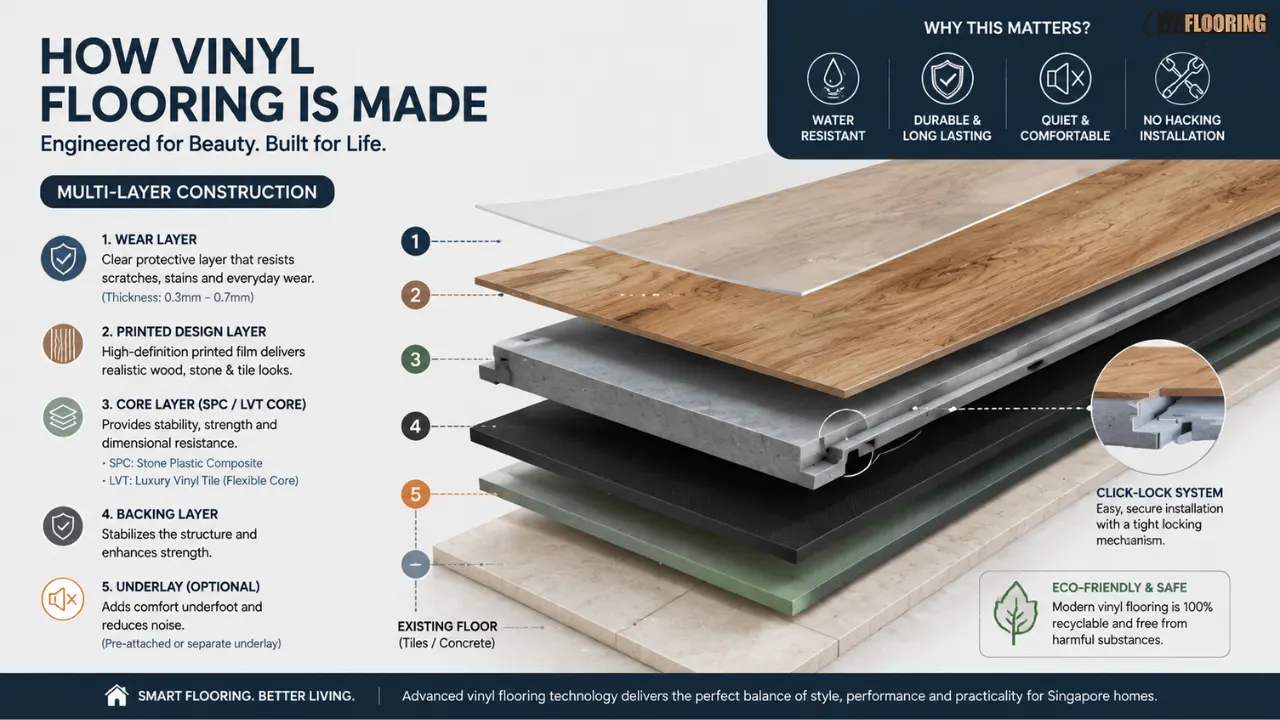
Vinyl flooring is a manufactured product whose base material is PVC, polyvinyl chloride, mixed with various additives to control flexibility, durability, and performance characteristics. Unlike natural flooring materials (stone, timber), vinyl is entirely manufactured, which means its properties can be engineered rather than simply found.
Modern residential vinyl flooring is a multi-layer product rather than a single material. At the bottom is a base or backing layer that provides structural stability and a bonding surface. Above that is the core layer, whose composition varies between product types: flexible vinyl in standard products, fiberglass in reinforced LVT, rigid stone polymer composite in SPC. The core layer determines how stable the floor is under temperature and humidity changes.
Above the core is the design layer: a high-definition printed image of whatever natural material the vinyl is replicating, wood grain, stone veining, marble pattern. The quality of this print has improved dramatically over the past decade, and modern LVT can replicate the visual complexity of natural materials convincingly.
At the top is the wear layer: a clear PVC coating that protects the print below it from scratches, abrasion, and staining. The thickness of the wear layer is the single most important specification in determining how long the floor will look good under residential use. Thicker wear layers (0.5mm and above) last significantly longer than thin ones (0.1 to 0.2mm) under equivalent traffic.
Why Vinyl Has Replaced Tile in Many Singapore Homes
Vinyl flooring has become the dominant choice for Singapore home renovations for reasons that make immediate practical sense once you understand the Singapore renovation context.
The no-hacking overlay installation is the most commercially significant reason. Singapore’s older HDB flats and condo resale units have existing tile floors. Replacing those tiles with new tiles requires hacking, a loud, messy, expensive process that costs S$3 to S$5 per square foot in demolition labour plus S$500 to S$1,200 in debris disposal and generates three to five days of disruption. Installing vinyl over the existing tiles requires none of this: the click-lock planks install directly on top of the existing floor in one to two days. For a 4-room flat, the no-hacking saving is typically S$4,000 to S$6,000.
Comfort is the second reason. Ceramic tile is hard underfoot. Standing on tile for extended periods creates physical fatigue in a way that vinyl does not. Vinyl’s composite construction is slightly softer and slightly warmer underfoot than tile, which makes a meaningful difference in daily experience, particularly in families with elderly members or young children who spend time on the floor.
Acoustic performance is the third. HDB buildings transmit impact sound between floors. The hard surface of ceramic tile transfers the impact of footsteps and dropped objects efficiently into the concrete slab and down to the flat below. Vinyl flooring absorbs some of this impact within its composite structure, reducing transmission. This is not just a courtesy issue, HDB’s renovation guidelines include noise performance requirements that vinyl flooring typically meets.
Pros and Cons of Vinyl Flooring
Vinyl flooring has genuine advantages and specific limitations. Understanding both allows homeowners to make an informed decision rather than a marketing-influenced one.
The advantages are: water resistance (fully waterproof at the core in quality LVT), low maintenance (sweep and damp mop, no specialist products), overlay installation without hacking, acoustic comfort over ceramic tile, warmth underfoot, realistic wood and stone aesthetics in premium products, cost efficiency compared with natural materials, and compatibility with Singapore’s high-humidity climate.
The limitations are: environmental durability constraints (it is not appropriate for sustained outdoor UV exposure), the inability to sand and refinish (unlike real timber), a visual and tactile experience that does not fully replicate natural materials at very close inspection range, and the fact that the floor cannot be permanently secured in floating installation (relevant for extreme weather exposure in fully outdoor applications).
Common Questions About Vinyl Flooring
Does vinyl flooring produce a hollow sound when walked on? A floating click-lock vinyl installation can produce a hollow sound if there is air gap between the floor and the subfloor. A well-installed floor on a flat substrate with appropriate underlayment does not produce significant hollow sound. Poor installation on an uneven substrate creates hollow spots. The quality of the installer matters as much as the quality of the product.
Does vinyl flooring become uncomfortably hot in Singapore? Vinyl flooring does not retain heat the way ceramic tile does. In Singapore’s climate, a ceramic tile floor absorbs and holds the heat of air-conditioned interiors in a way that makes the floor feel cold and then warm as the temperature cycles. Vinyl’s lower thermal conductivity means it feels more consistent in temperature and does not create the thermal shock of stepping onto cold ceramic on a hot day.
Does vinyl flooring get mouldy in Singapore’s humidity? Quality vinyl flooring does not support mould growth on its surface because it does not absorb moisture. The mould risk in vinyl flooring installation is beneath the floor, at the subfloor interface, if moisture is present and not managed before installation. A dry, properly prepared subfloor eliminates this risk. If your existing tiles have moisture beneath them, that should be addressed before vinyl overlay is installed.
How LVT Improves on Standard Vinyl
Standard vinyl flooring, particularly the older generation of thin, flexible, glue-down products, has a justified reputation for looking plasticky, sounding hollow, and degrading quickly in high-traffic areas. Modern LVT has addressed every one of these concerns through construction improvements.
The EIR texture technology aligns the physical surface with the printed design, creating a convincing visual and tactile experience that older emboss-only products could not achieve. The thicker wear layer (0.5mm vs. 0.1 to 0.2mm in older products) dramatically extends service life. The fiberglass-reinforced core eliminates the dimensional instability that caused older flexible vinyl to bubble and lift. The click-lock installation system removes the adhesive dependency that made older products difficult to install and remove.
The upgrade from standard vinyl to LVT is not just a quality improvement, it is the difference between a product that looks dated within five years and one that maintains its appearance for twenty. Explore the LVT upgrade path with CORE+ LVT and browse all Citiflooring brands to see the full product range.
Frequently Asked Questions
Is vinyl flooring the same as laminate flooring? No. Laminate flooring has a high-density fibreboard (HDF) core topped with a photographic print and a hard melamine wear layer. Vinyl flooring is PVC-based. Laminate is more susceptible to swelling from moisture exposure than quality LVT. In Singapore’s humidity, vinyl is generally more appropriate than laminate for kitchens and other moisture-adjacent areas.
Can vinyl flooring be installed in new BTO flats? Yes. New BTO flats typically have a concrete subfloor from the developer. Vinyl plank can be installed directly over the concrete subfloor with appropriate levelling compound where needed. This is a common renovation choice for new BTO owners.
How do I clean vinyl flooring? Sweep or vacuum regularly to remove grit. Damp mop with a mild, pH-neutral floor cleaner for routine cleaning. Avoid steam mops (sustained heat can affect the click-lock joints) and avoid abrasive cleaners that can damage the wear layer.
Does vinyl flooring require acclimatisation before installation? Click-lock vinyl plank benefits from 24 to 48 hours of acclimatisation in the installation environment before laying, allowing the planks to adjust to the ambient temperature and humidity. This reduces the likelihood of minor dimensional adjustment after installation.
Conclusion
Vinyl flooring in its modern, premium LVT form is genuinely one of the best flooring choices available for Singapore homes in 2026. It solves the problems that ceramic tile cannot, hacking costs, acoustic transmission, maintenance burden, while delivering visual quality that, in premium specification, is convincing enough to satisfy the most design-conscious homeowners. For those encountering vinyl flooring for the first time, the starting point is simple: ignore what you may have seen in older buildings, and look at what quality LVT delivers today.
Browse our vinyl flooring gallery at citiflooring.com.sg/product. |
