

“Vinyl flooring” is one of those terms that sounds specific but covers a surprisingly wide range of products. The entry-level sheet vinyl used in a hawker centre kitchen and the premium LVT installed in a design-led condo renovation are both vinyl flooring. They share a base material and almost nothing else: they differ in construction, visual quality, service life, installation method, and cost by a factor of several times.
Understanding the distinct types within the vinyl flooring category is not a technicality exercise. It is how you avoid buying the wrong product for your home and avoid comparing quotations for products that are not actually comparable.
Vinyl Sheet Flooring
Vinyl sheet flooring is the oldest and most basic form of the category. It is manufactured in continuous rolls, typically 1.83 or 3.66 metres wide, and installed by cutting to size and adhesive-fixing to the prepared subfloor.
Sheet vinyl’s primary advantage is its seamless surface. Because there are no joints across the floor, sheet vinyl is genuinely waterproof from edge to edge, liquid cannot penetrate between planks because planks do not exist. This makes sheet vinyl appropriate for utility spaces, commercial kitchens, and areas where maximum water resistance across the full floor area is the primary criterion.
The disadvantages of vinyl sheet are significant for residential renovation contexts. It requires adhesive installation, which means the existing floor must be hacked if it is not a suitable adhesive substrate, or a self-levelling compound must be applied to create an acceptable bonding surface. Removing or replacing sheet vinyl is difficult and typically requires hacking the adhesive bond. The visual and texture quality of sheet vinyl is generally lower than plank formats because the printing and texture technology applied to sheets does not achieve the depth and registration of modern LVT.
In Singapore’s residential market, vinyl sheet is used primarily in utility areas, service yards, budget commercial applications, and older renovations where it has not yet been upgraded. It is rarely the specification recommended for living areas and bedrooms in a modern residential renovation.
Vinyl Plank Flooring (LVP)
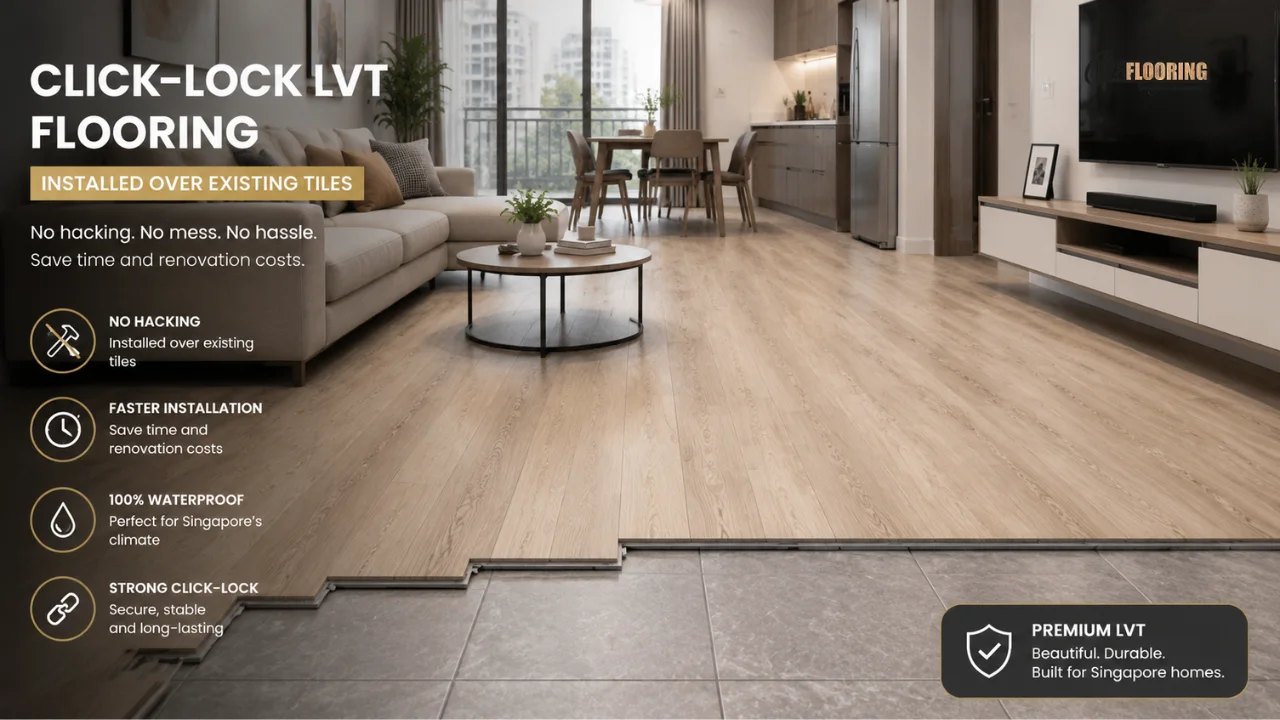
Vinyl plank flooring (LVP) is the dominant vinyl format in Singapore’s renovation market. Individual planks in widths of 150 to 230 millimetres and lengths of 900 to 1,800 millimetres replicate the visual format of timber floorboards and are installed either by adhesive or, in modern systems, by click-lock interlocking mechanisms.
Click-lock vinyl plank is the format that transformed Singapore’s flooring market. The floating installation system, where planks interlock mechanically without adhesive and the floor floats over the existing surface, allows vinyl plank to be laid directly over existing tile floors without hacking. This no-hacking overlay advantage saves Singapore homeowners S$3,000 to S$5,000 in demolition and debris costs per renovation project, which is a sufficiently significant saving to make click-lock LVP the default recommendation for resale HDB and condo renovations.
LVP spans a wide quality range. Standard vinyl plank at the entry level (2 to 3mm, thin wear layer) is a budget product with a short service life. Mid-range LVP (4 to 4.5mm, 0.3 to 0.5mm wear layer) is the volume segment of the Singapore renovation market. Premium LVP at the top of the range overlaps with LVT: 5mm or above, 0.5mm or thicker wear layer, reinforced core, and EIR surface texture.
Luxury Vinyl Tile (LVT)
LVT is the premium category within the vinyl plank and tile format market. The “luxury” designation refers to a specification level rather than a price category alone, it indicates a product constructed to deliver superior visual realism, longer service life, and better dimensional stability than standard vinyl plank.
The construction of quality LVT includes several elements that distinguish it from standard vinyl plank. The wear layer is typically 0.5mm or thicker, providing substantially better scratch and abrasion resistance. The design layer uses high-definition printing with detailed colour variation and natural grain or stone pattern reproduction. The emboss texture uses EIR technology that aligns the physical surface with the printed image, creating a convincing tactile experience. The core includes reinforcement elements, typically fiberglass, that improve dimensional stability in conditions of temperature and humidity variation.
LVT is available in both plank format (mimicking timber boards) and tile format (mimicking stone or ceramic tiles). The stone-effect tile format in LVT, sometimes called Luxury Vinyl Tile in the original sense of the term, produces stone, marble, and travertine-look floors that are significantly more practical than real stone in Singapore residential conditions.
CORE+ from Citiflooring is positioned as LVT: 5mm thickness, 0.5mm wear layer, fiberglass-reinforced core, Uniclic click-lock installation, and EIR emboss texture across all colourways.
Specialty Types: WPC and Rigid Core
WPC (Wood Polymer Composite) and SPC (Stone Polymer Composite) are evolution formats that modify the core construction of LVT for specific performance applications.
WPC uses a foamed polymer core that is lighter and has better thermal and acoustic insulation than standard vinyl plank. The foamed core makes WPC more comfortable underfoot, closer to the feeling of walking on carpet than standard vinyl, and provides better sound insulation between the floor and the subfloor. It is a relevant choice for bedrooms and spaces where acoustic comfort is prioritised.
SPC uses a rigid stone polymer composite core that is significantly denser and harder than standard LVT. The rigidity makes SPC more resistant to concentrated point loads, more stable over uneven substrates, and more appropriate for heavy commercial use. The trade-off is less underfoot comfort and more sound transmission than WPC. SPC is more common in commercial renovation applications than residential.
For most Singapore residential renovation contexts, standard LVT with fiberglass reinforcement, which sits between the softer WPC and the rigid SPC in terms of construction, is the appropriate specification.
Which Type Suits Your Home?
The choice between vinyl flooring types for a Singapore home comes down to where performance priorities align with the specific conditions of the space.
For living rooms, bedrooms, and the primary living areas of HDB flats and condos, click-lock LVT is the appropriate specification. The overlay installation saves hacking costs, the waterproof core provides moisture protection, and the EIR texture and wear layer deliver the visual quality and service life that a primary living space demands.
For bathrooms and wet areas, fully waterproof LVT in click-lock format with proper edge sealing is suitable. Sheet vinyl is also an option where seamless waterproofing is the highest priority and aesthetics are secondary.
For utility areas and service yards, entry-level vinyl or vinyl sheet is often adequate given lower aesthetic requirements.
For commercial applications, SPC or commercial-grade LVT with heavier wear layer specification is more appropriate than standard residential LVT.
Explore LVT Core+ as the recommended product for most Singapore residential applications, and browse the LVT gallery to see how different formats look in completed installations.
Frequently Asked Questions
What does “LVT” stand for and how is it different from “LVP”? LVT stands for Luxury Vinyl Tile. LVP stands for Luxury Vinyl Plank. The difference is format: LVT typically refers to tile-shaped vinyl that mimics stone or ceramic, while LVP refers to plank-shaped vinyl that mimics timber. Both are premium-specification products, and the construction quality that makes them “luxury” is the same across both formats.
Is SPC better than LVT for Singapore homes? Not necessarily better, different. SPC is stiffer and more resistant to heavy concentrated loads, which makes it more suitable for commercial use. For most Singapore residential applications, the fiberglass-reinforced LVT core provides adequate stability with better underfoot comfort than SPC’s rigid core.
Can I mix vinyl types in different rooms? You can use different vinyl products in different rooms, but visual coherence is easier to maintain when the same product and colourway runs throughout connected open spaces. Transition strips manage the junction between different flooring types at doorways.
Is WPC vinyl suitable for Singapore’s climate? Yes. The foamed WPC core is stable in Singapore’s temperature and humidity range. WPC is a good choice for bedrooms where acoustic comfort and a warmer underfoot feel are priorities.
Conclusion
The types of vinyl flooring available in Singapore, sheet, plank, LVT, WPC, and SPC, are not interchangeable. Each serves a different combination of performance requirements, aesthetic expectations, and budget constraints. For the majority of Singapore residential renovation projects, click-lock LVT at premium specification is the format that delivers the best combination of visual quality, service life, and installation practicality. Knowing what you are buying before you buy it is the simplest way to ensure the floor you install is the floor you need.
Browse our types of vinyl flooring gallery at citiflooring.com.sg/product. |
